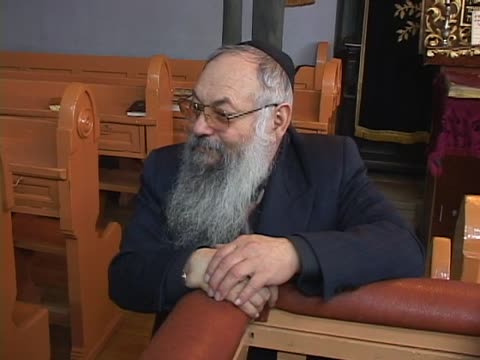
The rabbi explains symbols in the synagogue's decoration to Kerler: the depiction of the prophets, the women's gallery above, the arrangement of Stars of David and the months, and animal figures. Kerler relates the animal figures to a saying about being strong like a lion and swift like a deer. Kerler then asks him to tell about himself.
Names specific figures and symbols; Kerler's remarks on a saying.
Kofmansky, was born 1946 in Chernivtsi, provides personal information and talks about his family. His grandfather Chaim Sholem was a rabbi from Bălți. Kofmansky attended a private school and studied with a private religious tutor in the afternoons. He then talks about contemporary religious life and the synagogue, as well as shares more about his family. Kofmansky studied physics at the Chernivtsi University. Kofmansky raised a daughter and a son, who lives in Israel.
The rabbi says he was born in Chernivtsi in 1946. His parents came from Siberia, and his grandfather, a rabbi (a Belz Hasid, as the discussion suggests), taught him religion in the afternoons. He studied physics at the university and became a professor. He describes rebuilding the synagogue's kitchen and mikveh, daily minyan, and the small size of the community, which is shrinking through emigration. He names his parents, and a son in Israel and a daughter who teach. He talks about links with Chabad and Rabbi Zalman Abelsky in Moldova. Kerler explains the Indiana project.
Covers the synagogue's community size, Lubavitch and other contacts, the physics professor and Rabbi Abelsky, which the catalogue does not mention.
Kerler and others finish with the synagogue, and Russian phone talk about the crew's plans follows: leaving a book and going on to Moldova that day. The Yiddish in this stretch is largely garbled.
Mostly Russian phone conversation about plans rather than footage.
The second part of the tape is a formal interview with Roza (Reyzl) Ovsheevna Shternberg, born 1924 in Khotyn. Shternberg, nee Kerzhner, talks about her family. Her father, a merchant, was born in Khotyn. Her mother was also born in Khotyn. She explains that her parents worked for the well-off Jewish merchant Bordeynik. He had business contacts to America (also see MDV 418). Shternberg recites a Purim shpiel, she remembers from her Yiddish teacher. Shternberg then talks about life today and sings a Yiddish song about love.
Shternberg starts the formal interview by naming relatives and friends from a list she has written. She gives her father's name as Yeshayahu, a merchant from Khotyn, and says her mother was also from Khotyn. Both parents worked for a wealthy merchant named Bordeynik. She recites a Purim play verse she remembers from her teacher, and tells of dressing up as a child and going from house to house. She sings a song about a youth in a kibbutz or hakhshara, and Kerler asks for another song.
Includes first mention of the song with kibbutz words.
Shternberg talks about her family, in particular her sister who was in the Zionist organization “Hashomer.” She explains that her sister went to Palestine before the war, but returned Khotyin when the war broke out. Shternberg grew with three sisters and one brother. She then sings the melody of the well-known Yiddish song “Vu bistu geven?” (where were you) with a different text, dealing with kibbutz.
Shternberg talks about her sister, a member of Hashomer, who went to Palestine but returned to Khotyn when the war started. She also gives her family name (Kerzhner), her mother's name (Nekhe) and her grandparents' names, Leah and Hersh. She names three sisters and a brother, and tells what happened to them in the war: evacuation and Siberia. She sings the kibbutz text to the melody of "Vu bistu geven", and Kerler asks about a Yiddish expression for a non-Jew.
Gives the grandparents' and siblings' names; also has a short Yiddish-language exchange.
Shternberg briefly discusses childhood memories of her hometown Khotyn, before she talks about her life during the war. She attended a Romanian school and explains that twice a week the Yiddish teacher Yanever would visit the school, whereas the non-Jewish students were taught by a priest during that time. Shternberg recalls how her teacher would compose songs for holidays. She then remembers the words for a Passover and Hanukkah song her teacher composed. Shternberg then sings a number of well-known Yiddish songs.
Shternberg describes Khotyn as a commercial town with many Jews. She tells how the town was bombed in the war and how the Jews in prayer shawls begged the Germans not to burn it. Her father was killed. She also recalls the Romanian school, where her Yiddish teacher Yanever came twice a week while the Christian children had religion lessons with a priest. She recites the Passover and Hanukkah songs that he composed, and sings other songs, including a Shavuot song of the cheder. Kerler asks whether non-Jews became Jews in Khotyn; she says this was not known.
Adds the wartime bombing of Khotyn and the singing, with Kerler's question on non-Jews becoming Jews.
Shternberg talks about Purim customs and the throwing of beans (?) at the synagogue or cheder. She sings a long humorous song about a poor teacher who emigrates to America and falls in love, then loses his bride at the wedding. Kerler and she discuss a film or theatre piece and other songs.
Shternberg answers Kerler's questions about Jewish weddings in Khotyn. She recalls the chuppah, dancing, and the badkhn, who sang for guests and the musicians' pay. She mentions a custom of a song for the in-laws and the music played for the wedding. Kerler asks about the word for the pay, and about non-Jews in Khotyn who spoke Yiddish; she says many of them were servants of Jews.