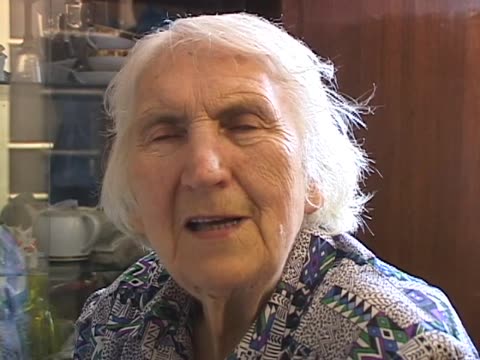
The first part of the tape is a continuation of a formal interview with Roza Ovsheevna Shternberg. Shternberg sings a couple of Yiddish songs about the good relationship between mother and daughter and about dowry.
Shternberg talks with Kerler about the recordings being kept in an American university archive and about her son having seen them on the internet. She then sings songs about a mother and the world in which young men sell themselves for money, and about a bride and her dowry.
Also includes talk of the archive and the internet before the songs.
The second part of the tape is formal interview with Shternberg’s husband Solik (Tsolel) Chaimovich Ziselis, born 1905 in Khotyn. Ziselis provides personal information and talks about his life during the war, imprisoned in the Tulchyn ghetto. He fled the ghetto and hid in the military barracks. He tells episodes about survival. He then talks about his family during the war. His father was a kosher butcher and a mohel.
Ziselis gives his name and patronymic and says he is from Khotyn. He recounts the war years: Tulchyn, hangings, forced labor, and escaping from the work column to hide in the barracks with the help of an acquaintance. He describes shootings, the death of acquaintances, and his father the shoykhet who was shot. The transcript is garbled and details are uncertain.
Also gives the Yiddish name Tsolel ben Chaim and mentions the lack of a minyan today.
Ziselis briefly recalls the beginnings of German occupation. He then talks about prewar Jewish life in Khotyn. In particular, Ziselis describes how his father traveled to the rebbe of Chortkov to receive blessings for his family. Ziselis grew up with a sister and a brother.
Ziselis briefly recounts the German entry and shootings in the streets, then answers Kerler's questions about his cheder and teacher. He tells of his father travelling with others to the Chortkov rebbe for blessings, and of his mother's reaction to the blessing. He names his siblings, including a sister Esther Beyle.
Includes the cheder and the teacher, and a visit to the Chortkov rebbe.
Ziselis talks about his family, in particular matchmaking for his sister. Ziselis worked as a kosher butcher together with his father before the war. His brother moved to Belgium before the war.
Ziselis talks about his family, in particular his sister's schooling at the gymnasium and a conflict over Sabbath work, and his father's attempts to find a match or money. Kerler asks which two rebbes had blessed the family. Ziselis says he worked with his father as a shoykhet before the war, and that his brother studied in a yeshiva and then in Belgium.
Adds his sister's gymnasium schooling and his brother's yeshiva studies; the details of the matchmaking story are unclear.
Ziselis talks about prewar Khotyn, as well as about his work as a kosher butcher after the war. Ziselis worked with the kosher butcher and mohel Moyshe from Berdychiva and traveled to neighboring towns. He then talks about contemporary religious life.
Ziselis speaks about prewar Khotyn and his work as a shoykhet after the war, travelling to nearby villages and small towns. He worked for several years with a shoykhet named Moyshe. He answers Kerler's questions about whether his father kept a notebook, and talks about a rabbi's school with many children. Kerler thanks him at the end and the talk turns to health.
Adds the question about the notebook and the closing talk about health.
Camera-only passage with sparse talk between Kerler, Ziselis and another speaker, partly in Russian, with little that can be made out. Some words about a hall or a concert may be heard, but the content is not clear.