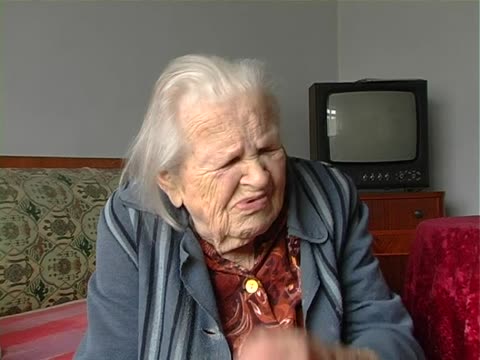
The interviewers enter the apartment and establish with Shames that she speaks Yiddish. Kerler gives the date as 25 May 2008 and the place as Khmil'nyk, and asks how the town name is said in Yiddish.
Shames gives personal details: her name, her father Shlomo, who worked in a mill in Yanoshpol, and her homemaker mother Sarah (Sharkeh). She had one sister, Niusye. Kerler asks about the town and its Jews before the war. She cannot recall the name of a nearby town where her father also worked.
Adds the names of her parents and sister and her inability to name the nearby town.
Shames answers brief questions about Yanoshpol: there was one synagogue in the small town, and her father was a miller. She says she had another sister who was killed.
Shames says only Yiddish was spoken at home. Her mother was Jewish, her sister was killed by the Germans, her father was also killed, and her mother later died. She did not know her grandparents and does not know where her father was born. His family had lived earlier in Lube (?) and moved to Yanoshpol when she was small.
Adds that her father too was killed, her lack of memory of her grandparents and the family's move from Lube (?).
Shames speaks about the war years and after. She worked in a factory in evacuation and then came to Khmil'nyk, where her mother had survived the war. She worked as an accountant, did not attend a Yiddish school (she was taught at home at eight), then switched to Ukrainian. She tells how her father was killed and how her mother hid and survived, and cannot recall details.
Adds her mother's survival in hiding, and the Yiddish-to-Ukrainian language change.
Shames says that after the war there was still a synagogue and a shochet in Khmil'nyk and people prayed, but later that stopped and Jewish life faded. Few Jews remain today because many emigrated to Israel. Lemster asks about her memory of the Jewish holidays.
Lemster asks about prewar holidays such as Passover and Purim in Yanoshpol. Shames says all Jewish holidays were observed and the synagogue was in use, but she gives few details, and says she cannot sing. Kerler asks whether the town's name has changed and whether there was a cheder, and she is unsure.
Adds the question of a possible renaming of the town and talk of the Jews leaving for Israel.
Kerler notes that her sister Niusye was killed not far from the town. Shames explains that the sister was handed to someone who took money to hide her but gave her up, and she was killed.
Kerler asks about childhood friends and school. Shames says she attended a Ukrainian school and there was no Yiddish school. After finishing she stayed at home helping her mother. She recalls a teacher who taught her Hebrew as a child, and Kerler asks about Purim food.
Adds the teacher who taught her Hebrew and the question about Purim food.
Shames remembers only buying matzo at Passover; she recalls no other holidays. She says her mother died long ago and she is alone. She mentions an aunt in America and a cousin who went to Israel.
Kerler praises her Yiddish. Shames says she is the only Jew left in her village or street and a Christian neighbour helps her. She describes her pension and her 20-odd years of service in a textile factory, where she worked in the laboratory and as accountant until it closed. She tells how she and her mother bought a house that was later taken and replaced by an apartment.
Adds her isolation as the sole Jew, her pension and loss of the house.
Kerler asks whether her mother made gefilte fish and whether she could read Yiddish books. She repeats that as a child she learned Hebrew from a teacher but forgot it. Questions about whether her mother taught her candle blessing and about the arrival of Soviet rule (1919 (?)) follow. She cannot recall details of her studies in a technical school elsewhere.
Adds the Sabbath candle question, the Hebrew teacher and her technical school.
Kerler asks whether she heard about pogroms before Soviet rule. Shames says she remembers that Jews were killed. He then asks about the Tisha b'Av custom of throwing burrs at people's beards in the synagogue.
Shames says her father remained a miller until he was killed. Her parents went to the synagogue on holidays and took her; as a child she could read Hebrew but now knows nothing. Kerler asks whether non-Jews in Yanoshpol spoke Yiddish, and she says no. She remarks on the synagogue's fate under Soviet rule.
Adds the question about non-Jewish Yiddish speakers and her father's work until death.
Kerler notes that Khmil'nyk was a spa town after the war and asks whether Jews came in summer. Shames says they did, but Jewish practice faded. She worked as an accountant in an office where Jews spoke Ukrainian or Russian. At home with her mother she spoke Yiddish.
Shames cannot name a town near Yanoshpol. Kerler asks about Jewish weddings, which she does not recall, since Soviet times had come. She says that at the synagogue she went with her mother. Yiddish was spoken before the war, but at work after the war Ukrainian. She says nobody is left to speak Yiddish, as few Jews remain.
Adds the language question and her view that few Jews remain to speak Yiddish.
Kerler asks about vodka and the word 'dybbuk', which she does not know. She recalls a holy site visited on yortsayt, with a rebbe before Soviet rule. Back in Khmil'nyk after the war she worked at a factory making boilers, in the laboratory and as accountant, before Kerler proposes a short Russian-to-Yiddish word test.
Adds the dybbuk question, the holy site and the rebbe.
Kerler and Lemster run a Russian-to-Yiddish vocabulary questionnaire with Shames. Items include greetings, animals (mouse), body parts, kinship, adjectives, the words for pious and honest, enemy, and the rich man. She often does not recall the word, and sometimes answers in Ukrainian or Russian-influenced forms. Sample sentences are translated and the interviewers thank her.
Kerler invites Shames to tell something freely in Yiddish; she says she has nothing to tell and did not expect the visit. The interviewers explain they study the Yiddish language. She says she learned Yiddish as a child and speaks it now with nobody. She describes working for 23 years in a textile factory, where co-workers spoke Russian or Ukrainian because the boss was Christian. She recounts evacuation to the Urals, her parents being taken, her return to Khmil'nyk, where her mother had survived.
Adds her statement that she speaks Yiddish with no one now and the account of evacuation and return.