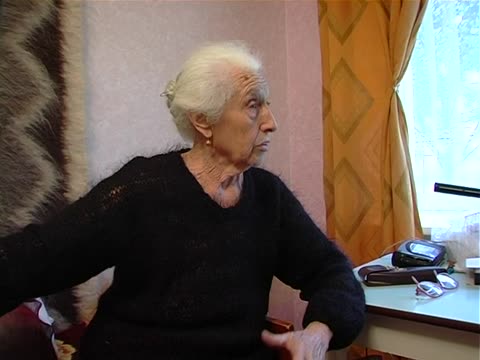
Greetings at the start of the visit: Kapustina speaks Ukrainian/Russian, and Lemster tells her in Yiddish where he comes from; she says her Yiddish is largely forgotten. She mentions that her father was killed, perhaps in a camp, and that she has calendars and Jewish holiday material.
Kapustina speaks about her family. She explains that the interviewers can have the tape sent to America, and that her brother lives in Los Angeles. She was born in Khmil'nyk; she gives her maiden name Kolomeir and her first name Sonya. Her father was a simple worker at a poultry combine, her mother was Liba. She discusses her grandfather Mordkhe, who traded in leather and built a house for his daughters, and her paternal grandfather Meyer, a leaseholder from a village near Khmil'nyk. She names her three brothers (Grisha, Avrasha, Nyoma) and talks about her second brother's illness and her own operation.
Names the brothers and details of the grandfathers' occupations; also mentions the brother's service and emigration of children to America.
Kapustina and Lemster discuss the ghetto in Khmil'nyk. She says it was on Shevchenko Street, and that some people ran away. Kerler asks how many Jews lived in Khmil'nyk before the war.
Gives the street of the ghetto and the number-of-Jews question.
Kapustina does not know how many Jews lived in town, and instead shows a Jewish calendar and a booklet on blessing candles and holidays, written in Russian.
Kapustina reads from a booklet about Passover, which has Hebrew text in Russian letters. She recalls that her parents kept Passover carefully, that her father fetched Passover dishes from another town and kept them in the attic. Her mother could read Hebrew and the prayer book.
Answers questions about her mother's education. Her mother was literate, but in Yiddish rather than Russian, and could read the prayer book; the transcript does not make clear whether she attended a private school or other school. There was no cheder at that time.
Kapustina answers questions about her Jewish school, which was later converted to a Russian one. She recalls the teacher Zhuk, a principal, and a wall newspaper. She says that she has forgotten Yiddish and that her relatives did not go to Israel.
Kapustina recalls her grandparents and childhood. She tells how her grandfather's son-in-law, her uncle, who had a mill in a village (Kirilovka), disappeared during the war and was found by the riverbank, recognised by his gold rings. She tells about the search for her grandmother's grave and says that childhood was poor. Kerler then asks about synagogues.
Covers childhood memories of grandparents and the grave search, besides the uncle's death.
Kapustina talks about synagogues in Khmil'nyk before the war, a large two-storey one with a women's gallery where she went with her mother, now used differently. She describes the streets where the family lived, Voronovska and the street near the river, and where the synagogue stood. Kerler asks about street names.
Talk about the research team: Kapustina asks where the interviewers come from, and they say America, Israel, Poland and Belarus. She mentions that Russian visitors had come before.
Answers questions about Yiddish theater and literature. She does not remember a Jewish theater before the war, and recalls only grammar lessons with a teacher who taught Sholem Aleichem's Tevye, before the school was closed. She read Russian and Ukrainian authors such as Pushkin and Tolstoy.
Kapustina talks about her work after the war. She says she did not read Yiddish. She was asked to take a job at a textile factory, using her ten years of school, and says her father was shot, in one of six graves. There was nowhere to live.
Pause in the interview, with Kapustina showing documents. Lemster and Kerler ask her to talk about earlier life, and she begins to describe how they were led out, with no cellar.
Kapustina describes being gathered in winter 1941–42: the family went to her aunt's house to be together, her father heard Germans on the road, and they were led in deep snow past the bridge toward a pit, with dead bodies lying about.
Kapustina describes life after the war: raising her young brother, working her way up to chief accountant in Khmil'nyk, and later her marriage and her husband's departure to America. She describes her relatives in Israel (Netanya), Los Angeles and New Jersey, her visit to Israel in January 1991, and her long account (largely Russian) of trying to get an Israeli, then American, immigration, being refused over pension and medicine. She says she is upset and lives alone.