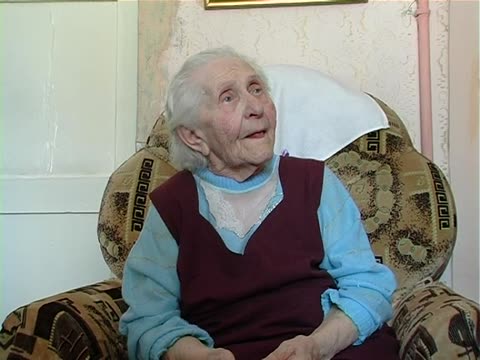
A formal interview, mostly in Russian, with an elderly woman from Odesa who says she knows no Yiddish. She recalls her grandfather's Passover seder and her father, who trained as a draftsman and architect in Odesa and studied in Switzerland. She also describes her private Russian gymnasium, antisemitism around Palm Week, and the hardships of revolution and civil war. She speaks of regretting not learning Yiddish, a Ukrainian husband who knew a few Yiddish words, and an episode at work in Bershad' when she could not understand a conversation in Yiddish.
Introductions with Beigel. She says she lives alone, with a son and grandchildren elsewhere. Her Yiddish name is discussed, and she says few Jews are left in the town. She gives her birth year, 1924.
Beigel gives personal information. She was born in Tyvriv, once a Jewish shtetl whose Jews were killed in the war. She gives her married surname (Beigel), her maiden name (Pansky) and her patronymic. Kerler and Lemster ask about her Yiddish name and the custom of double names, and about her son's name.
Adds discussion of how the town and the Yiddish name are said.
Beigel talks about her childhood in Tyvriv and the family's departure in 1932. She gives her father's name and birth year and his work, her mother Esther, and her siblings and grandparents. She remembers the hard life, and that the synagogue was closed in the mid-1930s so people prayed in private houses. She also mentions praying in private houses in Hnivan' after the war.
Adds the grandparents' names and occupations, and prayer in private homes.
Beigel compares Jewish life in Hnivan' with that of a shtetl. In Hnivan' there were few Jews, who gathered at home for the holidays. She does not remember Tyvriv's holidays since she was a small child.
Beigel remembers Passover seders and the prayer book she kept. She also recalls a wedding canopy at her own wedding in the 1940s, with scant food. She talks about her grandsons and what her son understands of Yiddish and Jewish holidays. She confirms that her parents were from Tyvriv, not far from a town whose name is unclear.
Adds her wedding, grandsons and her son's Yiddish.
Beigel describes Tyvriv as a Jewish shtetl with a center where Jews lived well, and Jews and their non-Jewish neighbors in the neighboring villages. The family fled a pogrom to Krasne, where they were taken in kindly, but after two years were sent back to Tyvriv and a ghetto.
Beigel speaks of the hunger and hardship in the ghetto, and says that no Jews remain in nearby Voroshylivka and only a few in Krasne and Tyvriv. The Jews left for Vinnytsya, America and Israel. At the end Kerler asks about the gefilte fish her mother made.
The catalogue entry names only food, but most of the passage is about the ghetto and the departed Jews of the region.
Beigel answers questions about food customs. She makes gefilte fish herself as her mother did, with a little sugar, and she makes matzo kugels and potato latkes. Kerler and Lemster ask about the dish names and what the latkes were eaten with. She says she has already told them what she lived through.
Adds questions about food terms such as latkes, and the cooking of kugels.
Beigel recounts the war: the family went to her mother's parents but a week later killings began, so they fled to Krasne and were later sent back. The Dnister (?) river divided the German and Romanian zones. She was beaten in the ghetto. An elder of the community bought her out so that she would not be killed. She also escaped bandits and hid with a Pole, and three times escaped being killed.
Beigel talks about her father's work after the war and her own studies and work as a medical assistant. She married a man who returned from the front and a former classmate; he was from Voroshylivka (?) and his father was killed. She names her siblings, Esi and Grisha, and her grandfathers.
Beigel tells of her father, who as a young man went to Odesa and worked for a landowner. He returned to Tyvriv, married her mother and bought a house, but the Soviets took it away.
Beigel and Kerler discuss a Yiddish blessing about long years and when it is said. She talks about studying at a technical college in Vinnytsya to be a medical assistant, and about a Jewish school in Tyvriv that she attended for a year before it closed, naming two teachers. She also mentions a fire brigade, a Georgian one (?), and the word for cotton wool, and does not remember non-Jews who spoke Yiddish.
Lemster asks Beigel for the meaning of Yiddish words such as dybbuk, golem, mesumad and others, and she gives explanations for some while unsure of others. She also talks about people of a religious sect who did not want to speak with her. The passage ends with a question about where the interviewers come from.
Adds the dialectology of dybbuk, golem and similar words.
Beigel talks about Romanian words and the Romanian presence in her war memory. Kerler asks the Yiddish word for cemetery, which she calls a field. She says her parents went to a cemetery in Vinnytsya on anniversaries, and that she prays there in her own words. She says her father and mother prayed but she attended a Ukrainian school, and she describes herself as half Jewish. The passage ends with a question about the importance of Yiddish.
Adds the cemetery term, prayer and her view of her Jewish identity.
Beigel speaks about her contacts in Israel: a sister's child, and two boys who work there. Lemster asks whether she knows Yiddish songs. Her parents sang Yiddish songs to her son, but she cannot sing and did not learn them, having gone to a Ukrainian school.