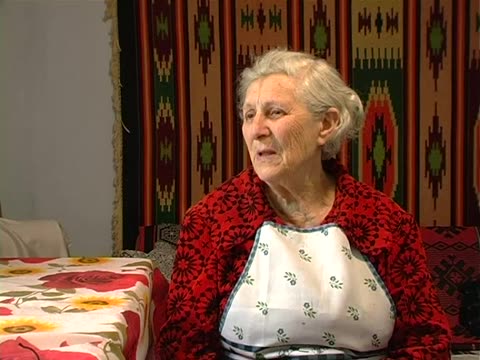
Beigel answers Kerler's dialectological questions. He asks her to choose between variant forms of prefixed verbs and of words for 'many', 'back', 'somebody' and 'suddenly'. The talk then turns to what language was spoken in Bessarabia, mixed with Romanian and Russian, and she and Kerler switch to Russian about Chisinau and the Israeli ambassador. Beigel says she now mixes Yiddish and Russian.
Beyond the questionnaire, a talk about Bessarabian speech, Chisinau and Beigel's use of Russian.
Beigel talks about life today. She has a few younger friends in Hnivan' with whom she speaks some Yiddish, though mostly Russian. She discusses radiation and emigration, saying people stay where it is good, but that Jews are not loved here. She does not remember songs.
Also covers emigration, antisemitism, a friend from another town and Beigel's inability to recall songs.
Beigel recalls Jewish weddings, at which people danced the freylekhs, and one after the war, perhaps her sister's daughter's. She and Kerler discuss the customs for the birth of a boy: the grandmother going out to distribute sweets to the children, and the naming ceremony. Kerler asks when a girl was named, and she says after a week.
The catalogue says the weddings were after the war and the religious customs before it; the transcript shows birth and naming customs, with the wedding mentioned only as dancing.
Beigel says she had no good years. The war began when she was a teenager and brought only hardship. Now she does nothing and her children help her. Asked about lullabies, she remembers none.
Beigel's wartime youth and lack of good years, and the lullaby question.
The interview winds down with joking about Kerler's status and a local young man who learned Yiddish. Kerler notes that a Christian cannot convert from Judaism. Beigel then discusses Jews in Kopaihorod and Sharhorod: none are left in Sharhorod, which had a ghetto. She mentions a book about it by an author now in Israel, which she read in Russian.
Adds the Sharhorod ghetto and the book about it, and the young man who learned Yiddish.