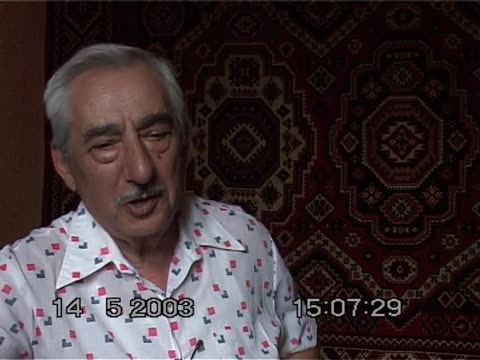
Bukshtein discusses cultural life before the war and sings a Purim shpiel. He mentions the local bathhouse and tells an episode about his mother, who consulted the rebbe of Stefanesti about antisemitism.
Bukshtein begins with a remark in Russian about a gift of caviar from relatives in Israel, then recalls a Russian film and a young Jewish man. Kerler asks about Purim plays, and Bukshtein recalls Purim as the happiest holiday and a family that staged Purim shows (a nickname that is unclear). He also recalls Jews walking in the street in prayer shawls without anyone mocking them, and the bathhouse with its mikveh, and bathing in the river Prut. He names the rebbes of Sadagora and Stefanesti, and tells how his mother, after a non-Jewish landlord's son attacked relatives, consulted the Stefanesti rebbe, who reassured her. Kerler then asks how far Mekhebush (?) is from Donetsk.
The catalogue says the mother consulted the rebbe about antisemitism, but the transcript shows an attack by a non-Jewish landlord's son.
Bukshtein talks about contemporary religious life. He then talks about his encounter with the local rabbi before the war and answers questions about cultural and food terminology. Bukshtein also talks about traditional weddings and recalls one Jewish shiker (drunk) in his hometown.
Bukshtein recalls organising a minyan for a rebbe's descendant at the grave of an ancestor near the Lviv border, then contrasts a rabbi (rov) with a hasidic rebbe, and describes the town rabbi inspecting the kashrut of a slaughtered hen. Kerler asks about terms such as good Jew, honest, a good place in the cemetery, misnaged, Litvak and badkhn. Bukshtein recalls Jewish weddings, klezmer music and tunes shared with Ukrainian and Romanian songs, whether Jews drank vodka, and the town's one Jewish drunkard. He explains the pastry fladn, gefilte versus chopped fish, a dybbuk and a golem, and begins to recall a funeral from sixty years earlier.
Bukshtein also recalls organising a minyan at a rebbe's ancestor's grave and the start of a funeral account.
Bukshtein describes a Jewish funeral from his youth: the cortege stops at each synagogue, the burial society carries the bier on shoulders, and the cry of charity saving from death is heard. He mentions the charity box for buying cemetery land. Kerler asks about how the dead are invoked and then announces that he will put questions in Russian for translation into Yiddish.
Kerler puts Russian words and sentences to Bukshtein for translation into Yiddish: greetings, everyday words, adjectives and comparatives, words for house, mouse, window, sour and deaf. He also asks about sickness, piety, dialect words for bridge, brook and potato, and the sense of his answers. Bukshtein sings a short Zionist song and mentions a Yiddish poet's booklet. He says Jews at home would not drink and recalls drinking songs.
The passage covers a long run of translation items and the Zionist song, but the transcript shows only a brief mention of drinking songs.