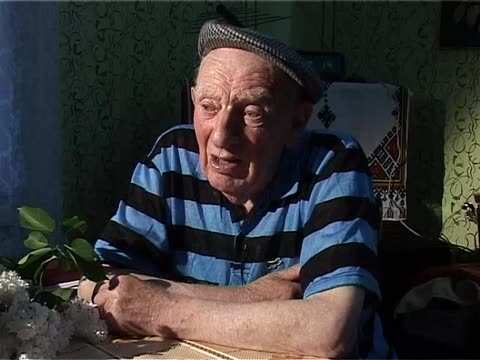
The first part of the tape is a continuation of a formal interview with Genrikh Moiseevich Katz. Katz answers a series of dialectological questions from the AHEYM Yiddish linguistic questionnaire.
Katz answers Kerler's questionnaire items. They cover Yiddish equivalents of Russian words and phrases (use or exploit, once, sometimes, suddenly, probably, a mistake, male) and a few Hebrew-derived words. Kerler explains differences in meaning, for example exploiting a person versus using a thing, and corrects Katz's reading of a Hebrew vowel sign. At the end Kerler thanks him for the help.
Besides the questionnaire, Kerler and the interviewee briefly discuss another interviewee who was a great help earlier.
Katz sings parts of well-known Yiddish songs, including one about a rebbe and one set by the Pripet river. Kerler and others react and discuss a Polish song, and Kerler thanks him and gives his own contact details.
Also includes a Polish poem prompt and Kerler giving his address.
The second part of the tape includes footage of the Ivano-Frankivsk synagogue. The camera records outside footage of the synagogue, before the team enters the building and talks to Rabbi Moyshe Kolesnik. The camera then records the morning service.
The synagogue footage opens with Kerler talking about the building and the rebuilding of Jewish communal life, with old Hebrew books, a menorah on the wall and commentaries. He mentions a book printed in Vilna and the Jewish settlement of Stanislaviv, now Ivano-Frankivs'k. He compares this with a synagogue in Bershad' (?), and most of the rest is the filmed morning service with almost no recognised speech.
The transcript shows Kerler's talk about the building and its books; the service itself has almost no recognised speech.
The team speaks with a number of congregants, including Froim Kalmanovich Bukshtein, about Yiddish dialects and regions. A congregant from Proskurov (today Khmelnytskyy) talks about his family members that perished during the war. He also briefly addresses his education.
Kerler talks with several congregants about where they were born, the Yiddish they speak and the language of their region. One man from Proskurov (Khmelnytskyi) talks about the Jewish population there, the family members who perished in the war, and his Russian schooling. There are also remarks on Litvak Yiddish, on Yampil and on Jewish life in Proskurov today. Kerler explains that this is a short interview for an archive and that the recording will not be shown publicly.
Beyond dialects and regions, the passage includes a Moscow-born congregant, Yampil, Litvak Yiddish, Jewish life in Proskurov and the congregants' schooling.
Informal conversation in Russian and Yiddish with congregants. A Dagestani (Mountain Jewish, Tat) congregant talks about the Tat language and Jewish life in Makhachkala and Israel. There is also talk about a Yiddish theater coming to town, an Israeli relative, and comparative forms in Yiddish and Russian. Kerler mentions a book by the poet Avrom Gontar (?) and says the team is going on to Chernivtsi to record living people. Parts are in poorly recognised Russian.
One congregant, probably Bukshtein, reads aloud Yiddish poems from a Soviet Yiddish book, including one about children and pine trees and another about a telephone conversation. He then shows a Yiddish newspaper he received from France in Soviet times and discusses articles in Yiddish papers. Kerler asks how he got them and says he would like to read them. The talk turns to a story by Anatoli Kuznetsov (a Soviet writer who defected) and to Baba Yar (?).