0:00
Cemetery footage.
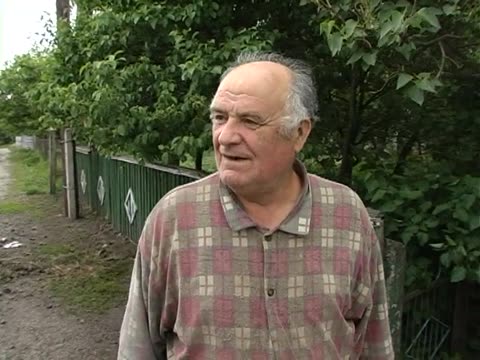
Cemetery footage.
Chat with caretaker.
Short exchange with a man at the cemetery, probably the caretaker, partly in Ukrainian and Russian. The team asks about the family name of a Jewish grave and about the address of a person who may be a possible informant.
Information about Yiddish-speakers.
Fishman is asked by the interviewers about remaining Yiddish speakers in Chudniv. He says only three Jews are left and names a few people, including a dentist who came from elsewhere. He says he understands Yiddish and the interviewers explain what they are looking for.
Jewish weddings and family.
Kerler asks Fishman about Yiddish songs and Jewish weddings, which he does not remember in detail. Fishman says his father was a Communist, and that religion was persecuted but old Jews gathered in a house. He says they marked Passover and that his father secretly sent food. Kerler asks how the prayer shawl was called.
Dialectology and family.
Kerler and Lemster ask Fishman a few dialect items, such as the words for mother, father, tallis and bread. He says his mother died in 1972 and his father in 1984, and that the family spoke Yiddish at home. He says there was a Jewish school and possibly two synagogues before the war, and does not know about a ritual slaughterer.
Prewar Jewish life.
Fishman says many Jews, including Hasidim, lived in Chudniv. He recalls that a small community used to come from Zhytomyr and met in a house, until its owner died in an accident. The community then dwindled, and he mentions that he has a daughter.
Family and life today.
Fishman talks about his family. His daughter is disabled, his son died after illness, and the Hesed in Zhytomyr helps with parcels. His sister lives in Baltimore with relatives in San Francisco, and cousins live in Israel and Canada; he gives their names, including Alla Fishman and a Feldman. He gives his name and patronymic and says he does not remember his grandparents. His grandmother died in evacuation in Kazakhstan.
Evacuation.
Lemster asks Fishman about evacuation and then for his address. He answers with a street in Chudniv.
Dialectology and family.
Fishman and the interviewers go through dialect items such as attic, cross, sick, sleep and tree. He says his father was born in Chudniv and his mother in a village nearby. He recalls that many Jews lived in Chudniv and then emigrated, and mentions his sister in America. His father held several posts, including chairman of an artisans' cooperative and factory director, and then retired on a small pension.
Beyond dialectology and family, the passage covers his father's career and the Jewish population of Chudniv.
Life today.
Fishman is asked what people knew in the Soviet years about the Six-Day War and emigration to Israel, and says very little. He recalls that television reached Chudniv in 1964. He says no old synagogue or Jewish school survives in Chudniv, and the interviewers thank him and take their leave.
Cut.
Religious life today and Yiddish press.
In Zhytomyr, Geller speaks Yiddish with the interviewers. They discuss the religious community today and whether children speak Yiddish, and the lack of Yiddish and Hebrew teaching. They also discuss the Yiddish press, newspapers and journals that still appear, and the Soviet-era publication Sovetish Heymland (?).
Geography of Pyatka.
Geller speaks about the geography and administrative history of his hometown Pyatka, which lay in the Vinnytsia region and later in the Zhytomyr region. Kerler asks about a Jew from Poland, and the two men then go into the synagogue.
Footage inside the Zhytomyr synagogue.
Footage in the Zhytomyr synagogue showing a man, named in the catalogue as Burshtein, praying and reciting aloud, with brief talk from people present. The speech is mostly garbled Hebrew and Yiddish and the content is not recoverable.