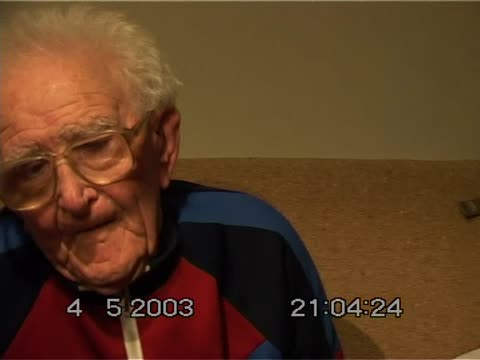
Vertman gives his address and personal data and says he speaks Yiddish. He talks about his family: his father Aren, born in Polonne, worked as a drayman for a householder; his mother Lite was born in Izyaslav and baked bread at home for sale. He names his two brothers and two sisters and their years of birth.
Gives details of the parents' origin and work and of each sibling's name and birth year.
Vertman says he worked as a typesetter at the printing house from 1932, and that after the war he worked again in the printing trade as a manager or engineer until retiring at 55. Kerler then asks him about his earliest childhood memories.
Vertman recalls his cheder education with the teacher Meir-Leib (the name is partly unclear) up to about age eight, studying the prayer book, Chumash and Rashi, then a four-year and a seven-year Yiddish school. He names the subjects, taught in Yiddish, and the writers read (Sholem Aleichem, Peretz, Markish, Kvitko), and mentions Ukrainian and Russian literature and the school director.
Gives the content of the cheder and school curriculum, the Yiddish authors read and the school staff.
Vertman says his mother was very pious and that his father went along with her. He describes the Sabbath meal kept warm in the closed, sealed oven, and discusses with Kerler the word for the Sabbath stew and the difference between chopped and stuffed fish. Despite the catalogue, the passage does not deal with typesetting.
The transcript shows Sabbath food and terminology rather than typesetting history.
Vertman describes how his religious mother ran the home, and how the Sabbath food was cooked on Friday and kept in the oven. He and Kerler discuss the stew term and the sweet, unsalted fish, and the difference between chopped and stuffed fish.
The passage is Sabbath practice and food terms at home, not the festival cycle as a whole.
Vertman recites parts of the Four Questions of the Passover seder in Yiddish. He says he had a bar mitzvah in the synagogue where the rabbi read and he kissed the Torah, but that the poor family held no party, only a drink. He also talks about the drinks and the schnaps and liqueurs that Jews drank.
Includes the recitation of the Four Questions and the bar mitzvah without celebration.
Vertman answers questions on holiday customs and food: kiddush on Sabbath, Passover dishes, Sukkot with the opened roof of the building, Hanukkah candles and potato latkes, Purim gifts and hamantashn, and Simchat Torah. He also describes Shavuot, when greenery was brought from the river to cover the floor, and what was eaten then (meat, fish, blintzes).
Vertman names the Jewish professions of prewar Izyaslav (tailor, hairdresser, teacher, doctor, typesetter, carter, baker) and says there were no Jews in the fire brigade. He says there was no antireligious agitation in his school, and counts seven synagogues, all wooden, in the old town and the new town, plus the Maidan district. He says the synagogues were broken up around 1930 and Jews prayed at home, and he mentions the Komsomol, a public library and Yiddish books.
Covers the Jewish occupations, the number and type of the synagogues, and the town districts.
Vertman answers Kerler's dialectological questionnaire in Yiddish: words (dybbuk, golem), greetings, adverbs of time and comparison, translations of Russian phrases and sentences, and the pronunciation of plurals. Other voices help with the answers. It also covers food and household words such as potato, dove, pigeon, groats, a window pane, and the question of where Lithuanian Jews and their speech were found.