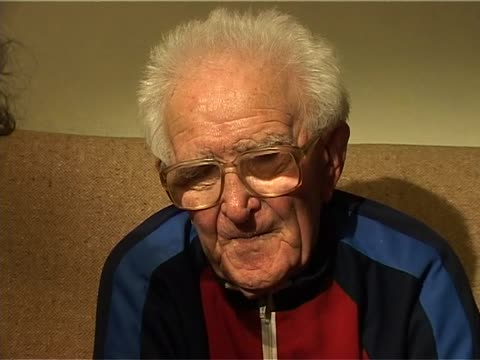
Vertman answers Kerler's final dialectological questions: words for a deaf person, the cantor's stand, Yiddish equivalents of Russian items, singular and plural of 'rich man', 'river', 'suddenly', 'various', 'each thing', and 'a lot'. Kerler also asks about the difference between rov and rebbe and whether there were Hasidim or an old-age home in Zaslav. Kerler then thanks him and ends the session.
Lys says the town had a large Jewish majority and a Jewish street where people sat and talked. His father prayed well, and synagogues were closed in the 1930s, with four or five remaining. His mother, also from Kornitsa, prayed and women came to her at the high holidays. He gives his age as 70, born in Kornitsa and registered in Izyaslav, and says his father told of a village club play after the revolution, which leads into a song.
Lys sings a humorous Yiddish song, about a woman asking a rabbi what to do when a neighbor makes her pot and then her husband unkosher. He says his father told him it was performed in the village club after the revolution. Kerler confirms he understands.
Kerler asks when the village club play took place, and Lys places it in the late 1920s. He describes Kornitsa as a Jewish shtetl where people traded in cows and boards. His father, a carpenter, had to leave after the militia threatened him and settled in Izyaslav after marrying. The end of the passage is garbled.
Lys says he finished first grade before the war. When the Germans approached in July, his mother packed and the family left by freight train. His father was drafted. After months of travel they reached a destination that sounds like Mordovia (?), where they lived about four and a half years. His mother worked and he studied, they were very hungry, and his mother wept over his swollen legs.
Lys says he spoke Yiddish with his parents, then attended a Russian school and an institute and became a teacher of Russian language and literature. He has been a school director for 38 years. He tells of his daughter, a teacher and translator, his granddaughter and grandson studying, and his son in Moscow, and mentions his father's holiday drink. Kerler asks about his parents' life, and Lys describes their marriage, his mother's elder sister, and his own marriage.
Lys says he heads the local Jewish community and gathers Jews in its office for Sabbath and holidays, since no one in town can lead prayer. He recalls his mother's candle blessing, and baking matzo at home with boards and a Russian oven. He begins on Samarkand, where his mother arranged Yiddish lessons from yeshiva students.
Lys recalls studying about two months with yeshiva students from Poland in Samarkand, after which he could not read or write Yiddish. He tells how, at eight or nine, he held a neighbor's boy at his circumcision. He then speaks of Lubavitch Hasidim and a phone call from Zhytomyr about the rebbe's anniversary. He describes the minyan he organizes in the office, saying kaddish from Russian transcription, and a visiting rabbi from New York who gave him tefillin to pass on to his grandson.
Lys speaks of his granddaughter, who studies Hebrew, lights Sabbath candles and visited Israel, and his hope that she will marry a Jewish man. Kerler then asks about prewar holidays. Lys recalls his mother's strict Passover kashrut and Sabbath, and his grandfather, a kohen. He also recalls his father, who read Yiddish and Russian books and Sovetish Heymland, the seder with the four questions in Yiddish, and that he holds a seder himself now.
Lys offers to show his mother's old baking dishes used for Passover kugel. A woman, possibly his wife (?), explains how the matzo kugel is made, with soaked matzo, eggs and salt baked in the oven, while Kerler asks what the dishes were called. Lys then begins on a letter about the Lys family name.
Lys describes a letter from a man researching the Lys family and his son-in-law's use of the internet. He arranged for photographs of old gravestones, since he cannot read the Hebrew inscriptions, and Kerler comments on how hard they are to read. In answer to S4's questions he gives Jewish population figures before and after the war. He describes how Jewish houses became few in the old town, and mentions intermarried neighbors and his own Jewish family.
Lys tells of the town's synagogues and says Jews prayed secretly in his father's house after the war. The synagogue buildings became an evening school, a music school and a factory. He describes celebrating Victory Day with Jewish veterans, the many Jews in professional and official posts after the war, and later emigration to Israel, America and Germany. He mentions a letter from a former teacher abroad, and Kerler ends with a Yiddish phrase question.