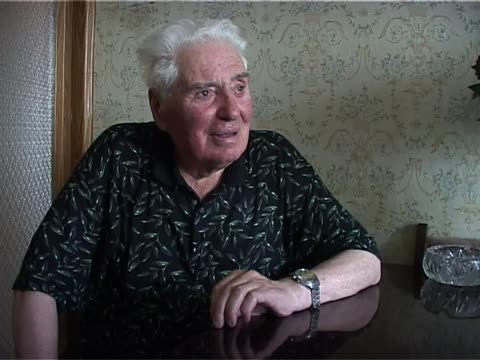
Kerler asks about non-Jews who converted to Judaism. Gelman recalls two brothers, shoemakers from the Pozamke (?) area, one of whom became a Jew and kept Jewish observance more strictly than born Jews. He then mentions villages in Russia of converts. Kerler asks about prewar Jewish sports clubs, the Kamianets yeshiva, Zionists and Hasidim, and Gelman remembers little beyond what his mother told him about Zionist meetings. He speaks about keeping yortsayt for his parents at home or in synagogue after the war, his one year in cheder, and his inability to read Yiddish letters. From about 12 minutes Kerler turns to dialectological questions. These cover the meaning of idioms, the Litvak (Lithuanian) Yiddish versus local speech, regional names for Jews, greetings and farewells, and many individual words (body, household, food, colors, adverbs, kinship, time words). The questionnaire also has sentences to translate. At the end a second person speaks Russian about a certificate, a prize and a son who is a sugar-factory director.
The catalogue gives only a label; the transcript shows converts, personal observance and a long questionnaire.