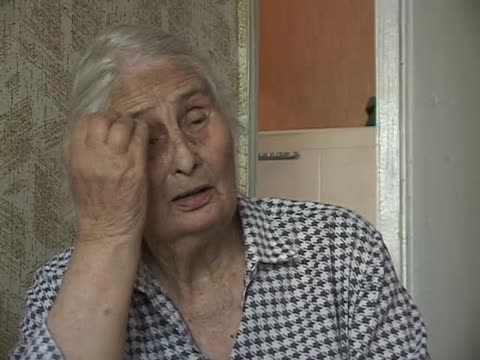
This tape consists of a formal interview with Mania Samuilovna Kraidman. In the beginning of the tape, a social worker and the research team try convince Kraidman to consent to be interviewed.
From the machine transcript
The interviewers explain that they want to interview and film Kraidman. She objects at first to being photographed or recorded, then begins to answer, saying that the war began in 1941 and that she was living in Babruysk. Kerler starts to ask about her childhood.
Shows that she says the war began in 1941 while the family lived in Babruysk.
Once she agrees, the interview begins. Kraidman was born in 1923 in what was then western Poland. Sometime in the 1920s her family moved to Babruysk, Belarus, then in the Soviet Union. There she completed 10 grades in a Soviet Yiddish school, where she studied four languages: Yiddish, Russian, Belarusian, German. In 1939, this school was converted into a Russian-language institution. Kraidman also recalls the town’s Yiddish library, where she attended a reading of “Notre Dame” by Gogol’ in Yiddish. Kraidman also mentions other Yiddish authors she read for school, such as Dovid Bergelson.
From the machine transcript
Kraidman discusses her name, which she says was recorded differently in her documents, and the name her mother used for her. She was born in 1923 in what was then Poland (the Brest region) and her parents moved to Babruysk in the 1920s. She completed ten grades at a Yiddish school there, studying Yiddish, Russian, Belarusian and German; in 1939 the school switched to Russian. She recalls the Yiddish library and reading aloud 'Notre Dame' to her family, and names Bergelson among the Yiddish authors she read.
Also covers her name and its spellings, and that she read the book aloud to the family.
Kraidman reads from the American Yiddish-language newspaper “Forverts”.
From the machine transcript
Kerler tells Kraidman that Moyshe Lebster, a Yiddish writer, publishes in the Forverts. Lemster asks whether she reads the Forverts and then asks her father's name.
The transcript shows only Kerler and Lemster speaking; no reading by Kraidman is evident.
Kraidman’s father, Shmuel, worked as a brushmaker and was from the Poland/Belarus border area. He came to the USSR, according to Kraidman, to find work. She has two younger siblings: Yoysef and Luba, the latter of whom lives in Israel.
From the machine transcript
Kraidman gives her father's name as Shmuel and says he was a brushmaker who came from Poland near the Belarusian border, apparently because there was no work there. Her mother was Khane. She has a brother, Yoysef, who has died, and a sister, Luba, who lives in Israel in Kiryat Bialik.
Gives the mother's name and Khmel'nyts'kyy-bound question context, and the sister's town in Israel.
Kraidman moved to Khmel’nyts’kyy after the war. During the war she was evacuated to Uzbekistan, where she worked and took courses in accounting, enabling her to find work in Ukraine after the war.
From the machine transcript
Kraidman says she came to Khmel'nyts'kyy after the war. When the war started she was in Samarkand, where she had finished ten classes and wanted to go to an institute. As the eldest child she had to work, so she attended accounting courses, and after the war she was assigned to work in Ukraine.
Before the war, Kraidman spoke Yiddish with her family at home. During the evacuation, Kraidman switched to Russian, a language she reports speaking with Jewish workers from Odessa who were also evacuated to the same area.
From the machine transcript
Kraidman says she spoke Yiddish at home before the war. In evacuation she spoke Russian with the many Jewish workers from Odessa, working by day and studying bookkeeping in the evening. After the war she worked in Zhytomyr.
Kraidman married a man named Mikhail in 1945 in Zhytomyr. Although he spoke some Yiddish, they spoke only in Russian to each other. Her husband’s uncle lived in America, but they lost contact with that branch of the family when he died.
From the machine transcript
Kraidman married in Zhytomyr in 1945 to Mikhail, who knew some Yiddish, but they spoke Russian with each other and with their children. Her husband's uncle in America was written to once and answered, but his daughters then asked that no more letters be sent. Kerler asks whether she later had occasion to speak Yiddish in Zhytomyr or Khmel'nyts'kyy.
Gives the husband's uncle in America and the daughters' request to stop writing.
After the war, Jews in Khmel’nyts’kyy spoke only Russian at work/in public spaces, speaking Yiddish at home, if at all. Today, Kraidman reads and translates Forverts articles for other community members in Hesed (elderly welfare organization). She also shares her attitudes towards different dialects of Yiddish.
From the machine transcript
Kraidman says she goes to the Hesed, where she reads Yiddish newspaper articles and translates them for others. She says people spoke Yiddish only at home, not at work, in the 1950s–60s. Her mother spoke Yiddish like that of Poland, while she herself speaks the Babruysk Yiddish taught in school, which had eight Yiddish classes and then Russian. Kerler ends by asking whether she remembers poems from school anthologies by Hofshteyn or Peretz.
Adds Kraidman's views on where Yiddish was spoken and on the dialect she speaks.
Kraidman shares her few memories of the Yiddish school curriculum, remembering that they sang revolutionary songs in Russian.
From the machine transcript
Kraidman recalls little of her Yiddish school reading beyond the name Itsik Fefer. She says she is old, and the interviewers reply that she is among the youngest people they interview. Asked about singing at school, she says there was none, apart from revolutionary songs sung in Russian. Lemster then asks about her grandparents.
Kraidman mentions how her grandparents stayed in Poland, when her immediate family moved to the Soviet Union. Kraidman reports that she has a large family spread throughout the world; an aunt of hers also moved to the Soviet Union before the war; her children now live in the United States.
From the machine transcript
Kraidman says her grandparents stayed in Poland when her parents left; they had many children, some of whom went to America. One of her mother's sisters came to the USSR and has died, but her children live in America. Lemster then asks about her work.
Kraidman speaks about her work as an accountant and her two sons. Kraidman states that she can read and write in Yiddish fluently, but finds speaking difficult. She takes pride in the fact that she recently translated Yiddish-language archival material for a scholar from Kam’’yanets’ Podil’s’skyy for his dissertation research.
From the machine transcript
Kraidman says she worked as an accountant, including in Zhytomyr. She had two sons, one of whom died; the elder, about sixty and a pensioner, lives in Khmel'nyts'kyy. She says she can write Yiddish but speaking is hard. She tells of scholars from Kam''yanets'-Podil's'kyy University who found archival material in Yiddish and for whom she translated it for a dissertation.
Gives the elder son's age and residence in Khmel'nyts'kyy.
Kraidman briefly speaks about the liquidation of Yiddish organizations in Babruysk in 1939. She also talks about the town’s prewar Yiddish library in Babruysk and how she helped Hesed order and organize their Yiddish books today, despite the fact that no one reads them.
From the machine transcript
Kraidman recalls the Yiddish library, newspapers and books of prewar times and that it was popular with people of all ages. Her favorite author was Sholem Aleichem, with Mendele also named; she owned Sholem Aleichem in Russian and gave the books to her sister. She says she helped Hesed arrange its Yiddish books by author and title, though no one reads them.
Adds her favorite authors, Sholem Aleichem and Mendele.
Kraidman mentions that there was a person who taught Yiddish at Hesed recently, but this was a class which only emphasized speaking; reading and writing were taught in the Cyrillic alphabet.
From the machine transcript
Asked whether anyone in Khmel'nyts'kyy wants to learn Yiddish, Kraidman says a woman at the Hesed teaches only speaking. The students write Yiddish words in Russian letters. Kerler then asks about games she played as a girl; she says she did not play them.
Includes the question about childhood games that she dismisses.
Kraidman briefly discusses the Yiddish theater in Babruysk. Her parents would go to the theater, while the children would stay at home. Nevertheless, she remembers that the plays would be translations of world literature into Yiddish.
From the machine transcript
Kraidman says there was a Yiddish theater in Babruysk to which her parents took the children. She does not remember what she saw, but recalls it as translations of world literature into Yiddish, and Kerler mentions Tevye the Milkman as a possible play.
Kraidman recalls anti-religious propaganda that was promoted in school and at home. The only time she heard of anyone going to synagogue, in fact, was when her mother went to services in Zhytomyr in recent years.
From the machine transcript
Asked about religion at school, Kraidman says it was anti-religious and forbidden, with the authorities watching that nobody practised. She says she never heard of a synagogue in Babruysk; the only time she heard of anyone going was after the war, when her mother attended in Zhytomyr.
During and after evacuation, Kraidman spoke to her mother in Russian. Her mother would answer in Yiddish, as she never learned to speak Russian well.
From the machine transcript
Kraidman says that after the evacuation she spoke Russian to her mother, who answered in Yiddish because Russian was hard for her. Asked for a Yiddish song, she says she does not remember any.
Kraidman remembers the Yiddish journal “Sovetish Heymland” and recalls that its chief editor, Arn Vergelis, was a classmate of her husband in Lyubar, Ukraine. She also relates how Vergelis made friends with the famous poet Yevtushenko.
From the machine transcript
Kraidman recalls the journal Sovetish Heymland and says its editor Arn Vergelis was in the same school class in Lyubar as her husband. She says he befriended a Ukrainian writer, apparently Yevtushenko. She has not read Polyanker, recalls buying Yiddish newspapers at a kiosk, and has heard of Birobidzhan, where Jews went and later left.
Adds Polyanker, the kiosk, and Birobidzhan.
When asked if she remembers any stories or songs from her childhood, Kraidman replies that life was too hard for such things.
From the machine transcript
Asked about stories and songs from childhood, Kraidman says nobody told her any and her mother did not sing, because everyone had to work. Kerler thanks her and the exchange turns to wishes of good health, and Lemster begins asking about an article on Vergelis.
Kraidman shows the researchers an article from a Yiddish newspaper about Vergelis and Yevtushenko. The research team photographs Kraidman reading the Forverts.
From the machine transcript
Kraidman and the interviewers look at a newspaper article about Vergelis and Yevtushenko from 2003, and Kerler talks about the Forverts and a campaign against a writer. The team arranges to photograph her reading the Forverts, positioning the paper so her face and the title show.