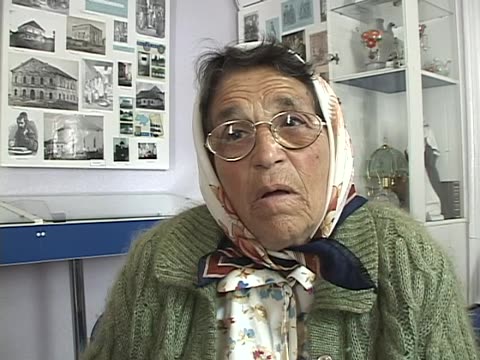
This tape is a continuation of a formal interview with Sura Melekhovna Bivson (née Frierman, b. 1926 in Polonne) conducted in Starokostyantyniv. Dr. Lemster asks Bivson questions from the AHEYM sociolinguistic and dialectological survey. Bivson also briefly discusses wedding and culinary customs from her youth.
Bivson answers Lemster's dialectological questionnaire. Items include the words for a top, a rich man, a wagon, a machine, an attic or floor, a ceiling, a face, a beard, a room, a cheder, a mouse, a kiss, a rabbi and rabbis, a Litvak's speech and a convert. Many answers are garbled or glossed in Russian. Near the end Lemster asks briefly about matchmakers and weddings in the shtetl and about a baked item (?) the mother made. Bivson then speaks of her age and says there is little to tell.
Includes talk about a Litvak's way of speaking and about conversion.
Bivson shares her views on what it means to be a Jew, stating that Jews are morally decent people, who have love and pity for other people and animals. Dr. Lemster then returns to the linguistic questionnaire.
Bivson answers what it means to be a Jew: having pity for everyone, loving animals, and being honest and good. She mentions her two cats and a dog and her flowers. Lemster returns to the questionnaire with items on flowers and a flowerbed, a Yiddish expression, 'come', and the word for book. She then speaks of her age, the war and the people she lost, and of her forty years as a telephone operator, including calls from Israel.
Adds her work as a telephone operator and the people she lost.
Bivson describes the peaceful, Yiddish-speaking home she grew up in, with a good mother and a father who worked and handed over his earnings, and says this is why she is as she is. She recalls her mother's lighting of Sabbath candles and her own custom of lighting candles for a year after her mother's death. Lemster asks about prayers and songs she knew, and she says she does not remember them. She hopes that Lemster's students will be good people and will know Yiddish, and Lemster thanks her.
Adds her mother's candle-lighting, her own candle-lighting after her mother's death, and Lemster's closing explanation of the recording.