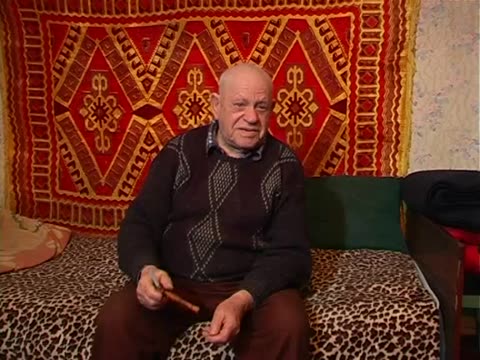
This tape consists of a formal interview with Aba Davidovich Kaviner (b. 1921, Derazhnya). The research team searches for Kaviner’s apartment.
From the machine transcript
The research team looks for Kaviner's apartment, with Russian talk about house numbers and some confused Yiddish exchange. Kaviner is then heard briefly, and a name, Yosef (?), is mentioned.
The formal interview begins. Kaviner lists Yiddish writers from the area, and comments on the life and works of Mendele Moykher Sforim and other figures.
From the machine transcript
Kaviner and Kerler chat about local Yiddish writers from the area, including writers from Starokostyantyniv, Polonne and Medzhibozh. Kaviner then speaks at length about Mendele Moykher Sforim's life and wanderings, how he learned Russian and German, and his language and descriptive art, and ranks Peretz and Sholem Aleichem after him. Kerler states the date and place and turns to Kaviner's military service.
the long discussion of Mendele, Peretz and Sholem Aleichem's language and style
Kaviner recalls the higher education he received in Leningrad in a military school. He also tells the research team about his experience in the Baltic republics during the first days of the war and his evacuation soon thereafter to Moscow.
From the machine transcript
Kaviner recalls his schooling and being drafted into the army, then study at an aviation-technical military school in Leningrad and the rank of sergeant. He describes service in Lithuania (Shiauliai) and Latvia, and the first days of the war in 1941, when the airfield was bombed. He describes a railway-station massacre of fleeing civilians, a place he cannot name, and the evacuation to Moscow.
the station shooting of fleeing Jews and the Latvian/German attackers
He continues to relate his wartime experiences in Moscow where he paraded in front of Stalin. Switching briefly into Russian, he recites part of Stalin’s speech that he remembers to this day. He continues to talk about his military service, speaking about the different places he served, the wounds he received, and duties he fulfilled. He was demobilized in 1946.
From the machine transcript
Kaviner describes the parade in Red Square on 7 November 1941, where Stalin spoke. He recites parts of Stalin's speech in Russian, and Kerler asks him to continue in Yiddish. He tells of being wounded and in hospital near Moscow, of serving in an aviation regiment, of the first and second parades in 1941 and 1945, and of his medals and demobilization in 1946.
the Russian recitation of the speech and the wound he shows on his head and fingers
Kaviner shows his jacket of war medals and decorations, all the while telling more war stories.
From the machine transcript
Kaviner shows his war medals and explains some of them, including one for victory over Germany. He recalls a river crossing where the retreating Germans had destroyed the bridge and the advancing army laid corpses and wood across the gap to get tanks through.
In the immediate postwar period, Kaviner returned to Derazhnya, and then soon thereafter moved to Khmel'nyts'kyy in order to find work. He describes the hardships and famine in those first postwar years, as well as his career as the head of a carpentry workshop.
From the machine transcript
After demobilization Kaviner returned to Derazhnya, saw the graves of the murdered including his parents', and soon moved to Khmel'nyts'kyy to work. He describes the postwar famine and his work as head of a carpentry workshop, and says there were good and bad years.
Kaviner speaks about the continued existence of anti-Semitism after the war and the postwar Jewish community in Khmel'nyts'kyy that consisted of demobilized soldiers and internal migrants from the surrounding shtetlekh. Although many of these Jews eventually moved to other cities in the USSR, Kaviner reports that there was still a significant community in the town until mass emigration began in later decades.
From the machine transcript
Kaviner says antisemitism existed, exists and will exist, and gives an example from his working life under an antisemitic director. He describes the postwar Jewish population of Khmel'nyts'kyy, made up of evacuees and Jews from nearby towns, who later dispersed to Chernivtsi, Moscow, Leningrad and elsewhere, and then emigrated to Israel, America and Canada. Kerler asks about postwar Poland and about a synagogue, and Kaviner begins to speak about the town's prayer houses.
the comparison with postwar Poland and emigration abroad
Kaviner tells the history of Khmel'nyts'kyy’s synagogues before and after the war. In the postwar period, only two of the town’s original eight synagogues remained, and only one was available for Jewish use. In 1951, this was closed down by the authorities, and all of the community’s important figures were arrested on accusations of spying during the war.
From the machine transcript
Kaviner recounts the fate of the town's eight prayer houses: some were closed, one became a sports hall, and only the butchers' synagogue stayed open for the Jews after the war and was repaired by the community. He recalls famed cantors who visited, including Kaiserman and a blind cantor from Kyiv. He says that in 1951 the community's leaders were arrested as spies and the synagogue was closed and made into a sports hall until Gorbachev's time.
the famous cantors who visited the butchers' synagogue
Kaviner discusses the contemporary Jewish community in Khmel'nyts'kyy, recalling the history of its reestablishment, and its internal politics.
From the machine transcript
Kaviner describes the present community and its synagogue on Kamenets Street, which is cold and in need of repair, and the reconstruction led by a man named Igor (?) Aleksandrovich. He mentions another man called Hasid (?), who is building a more ambitious synagogue and has run out of money and a minyan. He complains that the community has dwindled because Jews have left.
the names of the synagogue's leaders and the rebuilding efforts
Kaviner speaks about his daughter and his grandson, and their respective education and career paths.
From the machine transcript
Kerler and Kaviner talk about Kaviner's daughter, a doctor in town, and his grandson, who finished school with a gold medal and an institute, worked in an international firm and then in an inspectorate. Kaviner hopes his grandson will marry a Jewish girl, and Kerler mentions Jewish matchmaking in Zhytomyr (?). Kerler then speaks of how nicely Kaviner prays.
Kaviner shares his views on prayer and religion, commenting on the place of both in his family life before the war. Noting his natural aptitude for learning, he describes the rapid progress he made in his religious education and what he remembers of it today. He also talks about the teachers from the yeshiva where he studied and the “open secret” status of the school under the Soviet Union.
From the machine transcript
Kaviner talks about prayer and his religious education. His father and grandmother arranged for him to learn from age three, and he went through a melamed, a talmud torah and a yeshiva, where learning came easily and he spoke Hebrew better than Yiddish. He tells what became of the yeshiva's teachers, who became bookkeepers, directors and mathematics teachers, and says the yeshiva was closed in 1938.
the sequence melamed, talmud torah, yeshiva, and the teachers' later careers
A teacher at a yeshiva, according to Kaviner, must be knowledgeable in modern math, science and history in addition to Judaica to be able to teach and understand traditional texts. He describes his school as not belonging to any one specific Jewish group, although they did follow the example of the Baal Shem Tov and other rebbes.
From the machine transcript
Kaviner and Kerler discuss why a yeshiva teacher needed to know mathematics, physics, medicine and history, as these were bound up with traditional texts. Kerler asks whether the yeshiva was Hasidic, and Kaviner says it belonged to no particular group but respected the Baal Shem Tov and the rebbes. The two debate Hasidim and mitnagdim, and Kerler asks him for stories about rebbes.