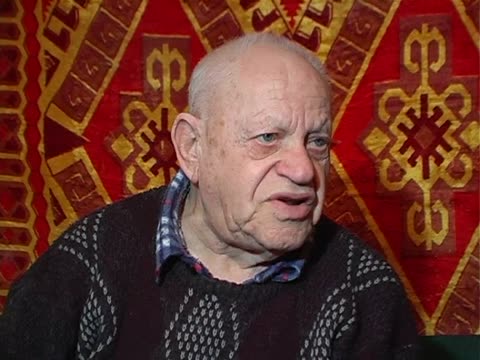
This tape is a continuation of a formal interview with Aba Davidovich Kaviner (b. 1921, Derazhnya). He tells several stories about the Baal Shem Tov (Besht), his encounters with different figures and his ability to see into the future. Kaviner also speaks about the origins of the Besht’s grave, its condition during the war, and his own personal visit to the site a few years ago. Kaviner reports that his first time in Medzhibozh was in 1946, when he spent time after the war traveling around to the graves of various tsadikim (holy men).
Kaviner tells legends about the Baal Shem Tov: his delay of Kol Nidre on the eve of Yom Kippur, and a note that he gave to an innkeeper for the later gabbai Yankl, which showed he could foresee the future. He also tells how the Besht forbade a gravestone, how the grave was marked and the state of the monument before and during the German occupation, when a cemetery guard was killed. Kaviner says he first came to Medzhibozh in 1946, after demobilization, while visiting the graves of holy men.
Besides the Besht stories, covers the gravestone and its wartime damage and Kaviner's 1946 first visit.
Kaviner names Yiddish writers he met before the war, when he was still a child, when they came to Derazhnya, including Itsik Fefer, Oyzer Varshavski (?), Leyb Kvitko and Dovid Bergelson. Answering Kerler, he describes what several of them were like personally: their build, Fefer's constant note-taking and others' manner. The passage ends with Kerler turning to stories about the Bratslav rebbe.
Kaviner discusses the history of Reb Nakhmen of Bratslav and his works, which Kaviner views as purely “theoretical” in nature. He also recalls how he read tales about the Baal Shem Tov in the works of various Yiddish writers, including those, such as Isaac Bashevis Singer, that he read clandestinely in samizdat.
Asked by Kerler about the Bratslav rebbe, Kaviner calls Nakhman a great theoretician and optimist who left a large body of writing and died young. He distinguishes the rebbe's teachings from stories about the Baal Shem Tov, which he says the Besht never wrote down. He says he read Yiddish writers such as Bashevis Singer in the Soviet period only in handwritten copies, since the Soviet press did not print them.
Includes the samizdat reading and censorship of Yiddish writers.
Kaviner and Kerler discuss Yiddish writers and critics, chiefly Nakhmen Mayzl, whose son Khayim, a doctor, Kaviner knew from the army, and Marek Varshavski, author of a famous song. They also talk about which Yiddish poems were not printed in Soviet times. Kerler asks him to sing something, and they talk about sending him materials and about writers buried in America.
Adds Mayzl's son, Varshavski and the request for a song.
Speaking about writers and their gravesites, Kaviner recites a poem-epigraph from a writer’s gravestone. He also tells the story of Sholem Aleichem and Maksim Gorky’s first meeting, and speaks about his connection to Bialik and Shmuel Halkin. With Professor Kerler’s help, Kaviner is able to recite part of a poem by Halkin.
Kaviner recites an epitaph from a Yiddish humorist's gravestone about hiding grief behind laughter, and tells an anecdote about Sholem Aleichem's first meeting with Gorky. He recalls reading Bialik in the 1950s and visiting Shmuel Halkin in Moscow, where Halkin told him to learn from Bialik. With Kerler's prompting he recalls fragments of a poem by Halkin, and then of Yiddish poetry he learned by heart.
Names Kaviner's visit to Halkin in Moscow in the 1950s and the recitation of fragments.
Kaviner comments on his health problems and the process of aging. He mentions how he burned the two novels he once wrote, and how he would try to write poetry, but is not confident he would have a wide readership.
Kaviner talks about old age: failing eyes, body and legs, and no longer being able to read Yiddish. He says he once wrote and burned two novels and thinks of trying poetry, but doubts anyone would print or read it. Kerler says it could be printed abroad and mentions cantorial recordings; Kaviner says he has no player, though his son has one. He also names Dudl Fishman, whom he saw in Moscow, and mentions mezuzahs and a Hesed director.
Adds the burned novels, the talk of publishing abroad and cantorial recordings.
Kaviner shows Professor Veidlinger different photos of recent life events, such as a meeting in Hesed (elderly welfare organization), a trip to Medzhibozh, and different moments with his grandson.
Kaviner shows photographs, including a trip to Medzhibozh to the Baal Shem Tov's grave with a rabbi and a community chairman, and a visit to a museum. In others he appears with his grandson, who received a medal and is shown at his graduation. Kerler gives him a Hanukkah gift and they say goodbye.