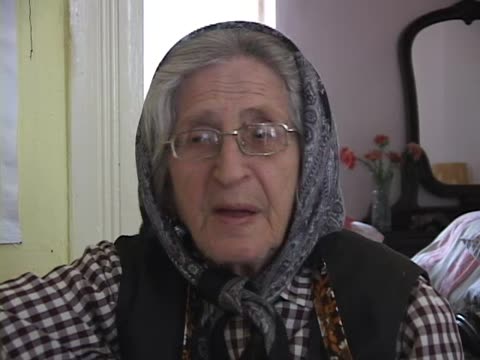
Snook sings a Yiddish song about the pains of emigration. The next song is partially in Hungarian and Yiddish about marriage and work. She recalls several prewar Zionist organizations, after singing a Zionist song.
Snook sings a Yiddish song about a lover's letter to America, then a song partly in Hungarian and Yiddish about a wife's refusal to work. She also sings a Zionist song about breaking down the wall of exile and building a Jewish land. Kerler asks about Zionists in her village, and she recalls the pre-war party and the many Jews who left for Israel. She says the community is now small and elderly and that Sunday classes in Yiddish exist, and she talks about her grandchildren's Yiddish and wishes Kerler well.
Beyond the songs, also covers today's Jewish community, Sunday school and her grandchildren's Yiddish.
Snook talks about Jews in Israel and America, saying they are decent and speak Yiddish, and she also mentions less observant Jews. Kerler asks what she makes of a word for such people (the transcript is unclear). She expresses thanks and good wishes to the team and speaks of her own health, her late husband and the hard years after the war. Katz and Kerler ask for another song, and the formal interview ends with talk of Yiddish books and her husband's prayer book.
Beyond Jewish life in Israel and America, also covers her health, her husband and her books.
The team looks through Yiddish and Hebrew prayer books in Snook's apartment. Kerler and Katz examine a women's prayer book and a siddur, and Kerler reads out a prayer. They read the printing details (printed in Lemberg and in Vilna) and an inscription on a book's owner, who was a ritual slaughterer. Kerler then asks about where Jews lived and the Jewish street, which has shops and factories.
Kerler and a second speaker describe the former Jewish neighborhood as the group walks to the synagogue. Once rich, with factories, it emptied after the war because the Jews left for America and Israel. Part of the talk, partly in Russian, concerns the market and shops nearby, followed by a conversation about Yiddish and a Jewish identity with a man who says he was brought up with Yiddish in the home.
The team enters the synagogue and the camera collects footage. Shimen Repkin explains the history of the synagogue in Russian. The synagogue was built in 1861 and closed down in the 1960s as part of the anti-religious Soviet decrees. The building was used as a social space for the adjacent factory. Repkin then talks about the prayer books in the synagogue and maintaining the building.
In the Khust synagogue Repkin explains its history in Russian: construction began in 1861, much of it is original, the paintings are original, the lions part came from Oleksandrivka, and the wiring was replaced two years before the visit. He recounts the Khust Jewish population in 1940 and its losses in the Holocaust, the ghetto from April 1944 and deportations to Auschwitz, and that Soviet authorities tried to close it for a club in about 1965–66 and a protest by women and children, apparently, saved it. He describes the books found there, with stamps from villages in the region and Yiddish, Hungarian and Slovak printings, and his catalogue of owners for a future museum. He also describes the repair of doors, donors from abroad, the mikveh-side rooms and a slaughtering knife found in the building, and talks about his own career at the shoe factory and the synagogue's upkeep, caretaker and minyan.
The catalogue sentences are supported; also covers the Holocaust in Khust, the books' owners and the doors donor.