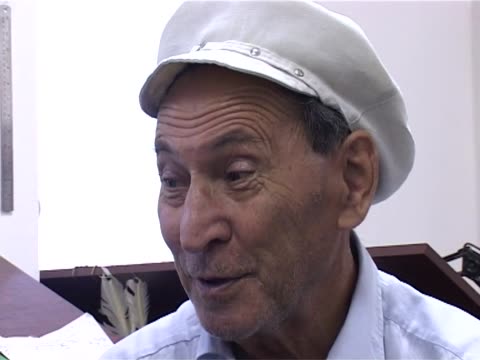
Setting up before the interview: arranging a room and a place to sit, with scattered talk among Kerler, Katz and the interviewee, partly in Russian. The speech is largely garbled; at the end the interviewee says they are meeting in the Brodsky Synagogue in Kyiv.
Smelanskii greets the interviewers, then talks about Yiddish schools in Smila from the 1920s to the mid-1930s, including a Yiddish technical school. He recalls a director and devoted teachers, classes up to the seventh grade, and moving afterwards to a Ukrainian school. He also mentions his maternal grandfather, who taught the grandchildren religion, prayer and Hebrew, and the grandfather's seven children, some of whom emigrated to America.
adds the grandfather's teaching and relatives in America
Smelanskii recalls his grandfather, a respected man in Smila to whom people came with questions, and the six or seven synagogues that stood until 1941. He lists uncles, aunts and cousins with their names, occupations and places (Moscow, Cherkasy, Kharkiv, Israel), says that relatives were evacuated or killed at Babi Yar in 1941, and mentions an uncle who ran the printing house of the Smila newspaper. He also says his father worked on the railway.
adds the extended family tree, relatives' occupations, the newspaper uncle and killings at Babi Yar
Smelanskii answers questions about childhood games, saying there were none beyond street gangs and fights. He explains the difference between a lane and a street in Smila and describes the town's rivers, the old mill destroyed by the Germans, and the two sugar factories, one of which was wrecked in the war. He also tells how the town changed after the war, and Kerler starts asking about Yiddish newspapers.
adds the geography of Smila (rivers, mill, sugar factories) and the lane/street terms
Smelanskii says Yiddish newspapers came from Kyiv and Moscow, and names classic writers such as Sholem Aleichem and Peretz, while saying no Yiddish writers visited Smila. He notes that young people left for institutes in the big cities before the war. He does not remember songs and says he was not a singer, and describes his work as a machine builder, with thirty-six years at one factory, and then as a dental-clinic mechanic making apparatus.
Short exchange in which Smelanskii says he made only the apparatus, not the teeth, in the dental clinic; Kerler then begins asking about the postwar years.
Smelanskii tells of four years at the front, being wounded twice, and service that began in the infantry and continued as a machine-gunner and then in the artillery. He mentions the Donbas and the Caucasus, hospital after his second wound, and staying in the army until 1948. He says he has lived in Kyiv since 1984, and that his first wife died in 1983 and a second wife died after five years.
Answers questions about Smila's synagogues and prayer houses, saying there were six or seven because Jews could not walk far on the Sabbath, and Kerler asks about the sabbath limit (tkhum shabes). He also says there were klezmer musicians, with violin, flute and drum, who played at weddings, and recalls the chuppah, and that the 1930s brought some pressure on religion. Kerler then begins a question about Jewish–non-Jewish relations.
adds the reason for the many synagogues and the sabbath-limit question
Smelanskii says many non-Jews in Smila spoke Yiddish. He tells of a Ukrainian priest near the monastery who knew the Jewish children, greeted Jews respectfully and had them pick apples in his orchard. Katz then asks about his earliest memories.
adds non-Jewish Yiddish speakers and the question that opens the earliest-memories passage
Asked by Katz about earliest memories, Smelanskii says he cannot recall them, and does not remember his grandmothers. His paternal grandmother lived in Cherkasy, and a paternal aunt's children included a son killed in the war. He says his father built a small prayer house after the war on returning from evacuation, and describes how a minyan needed official permission and a list of members. Katz asks about prayer and Russian is spoken at the end.
adds his relatives and the permission and list needed for a minyan
Katz asks about childhood prayers: the morning prayer modeh ani, the blessing over bread and the Passover seder with the four questions. Smelanskii recalls little and says he reads the Haggadah now. He mentions that he had asked someone about the Torah portions before the interview, and Kerler intervenes when the questioning sounds like an exam.