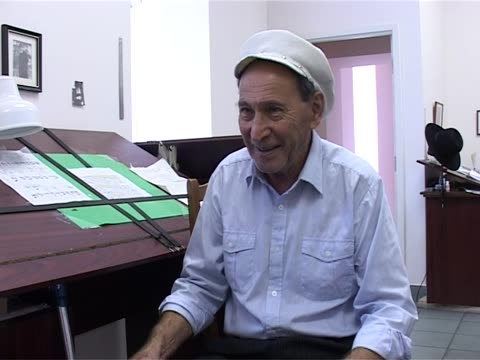
Katz and Kerler ask Smelanskii how things were said and done before the war: prayers read or sung, Passover songs, and a Passover play. He says he does not read them any more and recalls little. He recalls Hanukkah dreidels and small children being led into the synagogue with a flag and a red apple, probably on Simchat Torah. Kerler also asks about latkes made from rye flour or potato, and what the children threw at old men's beards. Katz then begins the Russian-to-Yiddish word questions.
The passage includes Hanukkah, Simchat Torah and latke questions as well as the reading of prayers.
A long dialectological questionnaire in which Kerler and Katz give Russian words and Smelanskii supplies the Yiddish, often commenting in Russian. Items include adjectives for sadness and joy, breathing and difficulty breathing, prophet and Elijah the prophet, "another story", one and a half, the afikoman, attic, potato, hen and rooster, blue, build, mouse, window pane, pigeon, soup, groats and deaf. He also contrasts how speakers in Smila and Cherkasy say some words. Near the end Kerler and others explain the archive project in Russian and Yiddish, as a video archive for scholars and students, and talk about consent forms.
The passage also contains an explanation of the archive's purpose and consent paperwork, and comparison of local Ukrainian usage.
After some talk about water and apologies for the long questioning, Kerler and Katz ask about Smelanskii's family. His grandfather and earlier forebears were from Smila, his father from Cherkasy, and his mother from Smila. The father's and mother's names are given, but the transcript is unclear. Questions then turn to synagogue and blessing terms: the one who stands at the lectern, the cantor's place, a blessing after recovering from illness or returning from war, and the thanksgiving blessing.
The passage also includes a questionnaire on synagogue and blessing terms.