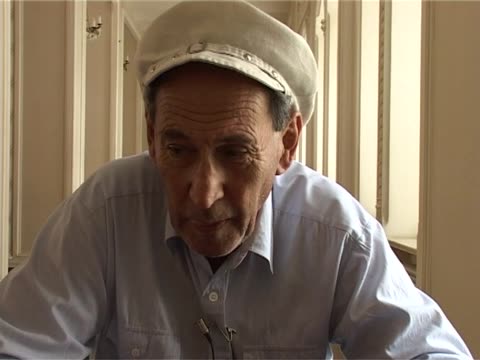
Questionnaire work with Smelanskii. Kerler asks how to say the year of his birth and ordinal numbers, then a series of everyday words such as room versus small room, cheder, pencil and pen, and the Friday evening before Sabbath. He goes on to the difference between a rov and a rebbe, forms of the verb for speaking, and the names Samuel and Shmuel. The last part covers the siddur and tefillin, and whether there were Hasidim in his town; Smelanskii says there were several rabbis but no Hasidim.
The passage also includes personal-name forms, the rov/rebbe distinction and tefillin, and the statement that there were no Hasidim in his town.
Smelanskii talks about the religious groups and prayer houses in his town before the war. Each trade had its own synagogue: tailors, shoemakers and others. He also mentions a distinction between groups in prayer (the transcript is unclear on the details). At the end Kerler starts a new question about stories of love affairs opposed by parents.
The passage names trade-based synagogues and ends with Kerler's question about opposed love matches.
Further questionnaire items put to Smelanskii by Kerler and Katz: words for bedbug, a branch or bough, spit, a pipe and the pair, going to court, and thanks. They also cover blessing someone for success, a doctor and a medical assistant, a flower, a shop and goods, and 'almost' and 'approximately'. Smelanskii often says he does not know or has not heard a word, and Kerler thanks him at the end. The last lines are partly Russian aside.
The team exchanges contact information. Business cards are given, and Katz and Kerler are identified by name for the informant, who wants to note their names. The conversation moves into Russian and the speech is largely garbled in the transcript. At the end Kerler brings up payment, in hryvnias or dollars.
Smelanskii addresses Jews in America with wishes for peace in the world and help for the Jews of Israel. Katz and Kerler then ask where Smila lies and what kind of Jews lived there. He says they were Ukrainian Jews, that he was born there, and that the town held ten to twelve thousand people, about thirty percent Jewish. He adds that few Jews remain and that many emigrated to Israel, and mentions his father's wish to see the Jewish land.
The passage adds that the numbers are about 10–12 thousand inhabitants, thirty percent Jews, and the present-day Jewish decline.
Smelanskii talks about his visit to Israel. He was there for some years (the exact period is unclear in the transcript) and mentions Jerusalem, Haifa and a place called Kiryat Malakhi. He also met invalids there and compares farming and irrigation in Israel with his own surroundings.
Smelanskii says he worked as an electrician. His father cast mines for the front during the war and before the war worked on the railroad clearing the tracks of snow, and after the war lived as a pious Jew on a pension. Katz then asks about close friends in Kyiv; Smelanskii lives alone but has friends at the synagogue. S2 begins a question about food in the town.
The passage adds Smelanskii's own occupation as electrician and his present friends and life in Kyiv.
S2 asks what was eaten and cooked in the town, and Smelanskii describes Sabbath food and everyday dishes such as homemade noodles, kasha and potatoes. His father was a shoykhet who slaughtered only fowl. Smelanskii himself learned shehitah, kept his father's knife after his death, and slaughtered for those who came to him. Knife sharpness is discussed, and the transcript is partly garbled.
The passage adds Smelanskii's own training as a shoykhet and his slaughtering of fowl after his father's death.