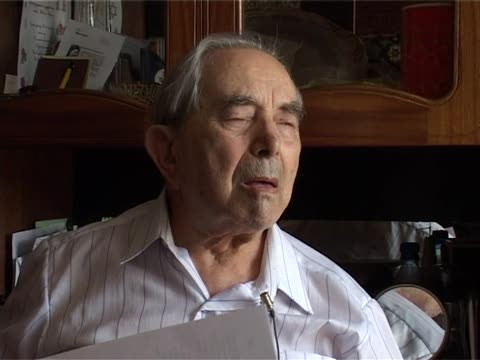
Informal talk over photographs. Shapiro identifies himself and his wife, who died not long ago, in a picture. There are exchanges about where people lived, one of them in English and Russian. Shapiro touches on his army service. Kerler then asks Shapiro to tell more about his childhood and earliest years and his kheyder teacher.
Kerler and Katz ask Shapiro about Jewish life in Vinnytsya before the revolution, including holidays, prayer and observance. Shapiro recalls a Jewish town with five rabbis and five synagogues, among them the Sandagerska (?) synagogue with a separate women's section and the Krochyk synagogue with a children's choir. He describes Yerusalimka, the neighbourhood where he was born, and his father's search for a larger apartment in the centre. He mentions his late wife's written memory of a Vinnytsya wedding, and explains that his father Yosele was a dayan, who settled disputes and was more popular than the rabbi.
Gives the layout of the Vinnytsya synagogues and Yerusalimka, his father the dayan Yosele, and his wife's memory of a wedding.
Shapiro shows family photographs, including relatives in Tel Aviv in the 1940s (?), and says one of them, a woman, studied piano and was a fine pianist. Kerler then asks about his kheyder and its teachers. Shapiro begins to explain why he ran away from it.
Moves from the photographs to the kheyder question.
Shapiro tells how he left kheyder at age seven because he could not bear the rabbi's beatings. The teacher was not clever and hit the boys, and Shapiro climbed out of a low window and refused to return. He recalls praying to God and his grandmother telling his parents, and his father then took him to a craftsman, apparently a jeweller, to learn a trade. Shapiro dislikes it and later works as a woodturner and shows some turned objects. Kerler asks him about two kheyder pupils who became religious judges and about the names of things.
Gives the reason for leaving kheyder, the teacher's name (Azriel (?)), his apprenticeship and woodturner work, and a Yiddish word he is asked for.
In part in Russian, Shapiro talks about his age at various points and mentions a document saying he was taken from Vinnytsya. Kerler asks about other prewar trades and tells him that interviewers trust the speaker more than papers. Shapiro says he was drawn away from Vinnytsya.
Shapiro says he was taken from Vinnytsya to a large factory in Kyiv, where he worked for some thirty years (?), and that a good reference praised his community work. He says he loved public work, was an idealistic communist, and was at the front during the war.
Shapiro recalls that during the war all officers were called out and told they must join the Communist Party, and he became a member. He mentions commanding a unit that built bridges and says he was given a large sum of money. He shows a small book and a document, partly read aloud in Russian by Kerler, praising him as an engineer and colleague for more than twenty years. Shapiro describes a recommendation for a better-paid post and a dispute about a trip to a place connected with Shevchenko. Kerler then asks about trades in Vinnytsya.
Covers his Party membership as an officer, his later engineering career, and a Russian testimonial read aloud.
Shapiro and Katz discuss getting help to continue the interview, with Kerzhner of Kyiv suggested. Kerler asks about Jewish weddings in Vinnytsya, and Shapiro says his wife's sister told him about them. He recalls holding the wedding canopy poles as a child. He recounts that in his time two Jewish schools, Krupitsky's and Faynshteyn's, opened in Vinnytsya, and that in these schools many Jewish pupils were taught in Russian. One of them had a large hall where weddings were held. Kerler asks about the klezmer groups.
Adds the plan to get Kerzhner's help and the language of instruction.
Shapiro describes the Krochyk synagogue before the revolution, with a choir of twenty and Yiddish singing, and funerals with a children's choir; Kerler and Katz question him about klezmer and music at weddings and burials. He says it was the finest synagogue, held services in Yiddish and was supported by wealthy members. Kerler and Katz ask him to sing a children's song, and he says he must prepare. He recalls being given a piano during the war by the wealthy Rabinovich, and being sent to Moscow to fetch an aeroplane and speaking with generals there. The passage ends as Kerler proposes a pause.
Adds the funeral choir, the piano gift, and the trip to Moscow.