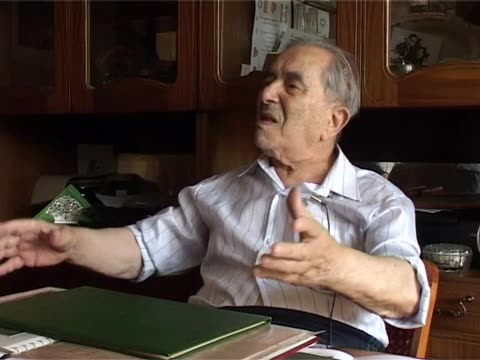
At the start the team is received in the house. The hosts discuss some books they want to give away and Katz says Kerler can take them, and Shapiro's helper is from Vinnytsya and now lives in Kyiv. Shapiro mentions his work at an institute, a congratulatory address and a gift of money from a former institute director, and the talk ends with the start of an account of his family and his orphaned father.
The passage is mostly about books to hand over, the helper's origins and funding, and begins his family story, rather than life today.
Shapiro talks about his family. He recalls a grandmother's story of a daughter's match to a young man who studied well but was poor, and the in-laws' reactions. He then mentions that Vinnytsya had five rabbis and five synagogues.
Includes a short exchange about the word for grandmother and the beginning of the Vinnytsya synagogue theme.
Shapiro describes the synagogues of Vinnytsya, among them a workers' synagogue and one connected with a hasidic rebbe, and Katz asks which kind of hasidim the rabbis were. He remembers carrying a tallis as a child, the women's section, a choir and music at one prayer house. He also says his father knew little Hebrew, and that he himself later became an officer.
Katz and Kerler explain who they are and what the AHEYM expedition is. Kerler mentions his father, the Yiddish poet Yosef Kerler. They discuss a Vinnytsya man (Glovman, name uncertain) and plans to meet him, and Kerler outlines the route of the trip (Vinnytsya, Zhytomyr and other towns). They then ask to see the books.
The segment also covers the Vinnytsya contact and the planned itinerary.
The team looks at five books that had been shown earlier and returned. The talk touches on a gravestone for a mother, a Torah scroll and a synagogue, and on photographing the couple and the books, but the transcript is very garbled.
It adds the discussion of photographing the host and wife.
Katz and Kerler divide the books: Kerler takes the Yiddish ones and the others are left with the Russian ones. The host's husband shows three small booklets he made about Jews in the war, and Kerler asks whether he wrote them.
Braverman talks about her Yiddish articles. She wrote a column and a piece about Shapiro's booklet, and mentions an article for a Kyiv newspaper on the state of Yiddish after the Soviet period and its anniversaries. She also speaks about a Yiddish periodical and a Yiddish lecture course, and about a writer from Odessa (Tishchenko?) who emigrated.