Talk about a Yiddish writer, evidently a younger man still active and of a hoped-for great age; the transcript is fragmentary. Kerler then notes that it is 7 July in Kyiv and says he is glad to talk with both of them.
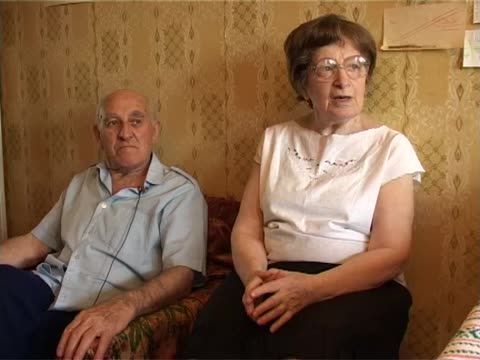
Kerler explains the video-archive project and the team's plan to travel to Shatmar(?) the next day. Braverman and Semyon introduce themselves. She comes from Solkhov, about 25 km from Berdychiv, was named Faigele, and was born in 1923 (Kerler makes a special exception to the post-1920 birth rule). Semyon is from Zhmerynka, his father from Hryntsiv (?) and his mother from Derazhnia; he finished Ukrainian school as the war began, was taken into the army, and did not hear Yiddish for fifty years.
Discussion of Braverman's childhood name and of the Solkhov name; Semyon's family names are also given.
Braverman recalls Solkhov childhood and mentions an essay she published about it. She describes her siblings, including a younger brother who was killed in the war, an older brother and sister, and a sister who died at age three, and how her parents hoped for a boy. She recalls a house without electricity and her grandmother coming with a basket of feathers and a Yiddish Pentateuch, whose pictures she looked at while hearing the Joseph story. An aunt in Tinkrad (?) gave her another book, and she recalls her grandfather praying in tallit and tefillin.
Details of siblings and a lost sister, and her own anecdote of wandering alone as a toddler.
Braverman describes holiday food: buckwheat latkes with goose cracklings and fat for Hanukkah, and potato latkes for Passover. She then recounts how her father's younger brother, a Zionist who founded a Jewish gymnasium in Solkhov, fled during the civil-war period, went through Poland and settled in France, and how the relatives there lived. She talks about her cousins in France, a cousin's birthday, and her own parents' fates: her mother was killed in Kalinovka. A discussion of where Kalinovka is follows.
Latke types, the uncle's Zionism and Jewish gymnasium, and the cousins in France.
Braverman names her cousins in France and their ages, saying they were four children in her family, too. She recalls relatives she was not allowed to know about because of fear, matzo parcels, and the family's expectation that grandchildren would care for the old. She describes her grandfather, his quiet manner, his shop that was kept secret until 1937, when a regional newspaper wrote that she had not mentioned it on joining the Komsomol, and his cabinet of books and Talmuds. A neighbor's apple cellar and an apple drink are mentioned, and the grandfather's death in the early 1930s (?) is recalled.
Details of other relatives and children in France; grandfather's cabinet of books.
Braverman describes her Yiddish school, which she attended for four years, starting before she was six, and her early reading of Yiddish, Russian and Ukrainian books. She recalls books left by her uncle's gymnasium (physics, archaeology, geography) and the novel Stempenyu that she read at about ten. She says she learned Hebrew only later. She names her teacher Litinetsky (Israel Borisovich), who she says taught Perets Markish, and recalls a difficult arithmetic problem and what her mother taught her.
Details on languages of books, her reading, and her mother's advice.
Braverman recalls poor wandering artists who came to Solkhov in winter, hungry and frozen. Her family took them in for Sabbath meals. She places this in the early 1930s, when her older siblings studied away at technical schools.