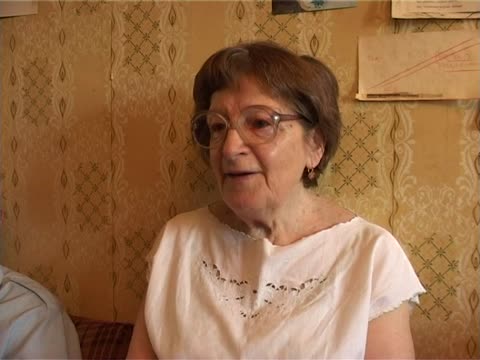
Braverman answers a prompt to tell something and recalls the theatre in Solkhov. Visiting artists lodged with the family and her mother cooked for them. She remembers a play and a song from it, and begins to tell about the town's doctor.
adds the mother's cooking for the artists and a remembered song from a play
Braverman describes the town's only doctor, a Russian field-surgeon, his non-Jewish mistress, and the scandal with his wife; Kerler asks about a dialect word. She recalls the fear of school and a rhyme spoken by an old woman when she was falling asleep.
adds the doctor's mistress and the old woman's sleep-time rhyme
Braverman repeats a rhyme about three women on a stone and recalls a lullaby for sick children. She discusses the ideal bridegroom in songs, a learned and rich man, and the Soviet literary ideal of poverty. Kerler then asks about the 1930s.
Braverman places the hunger in 1932–33 and speaks of her father's job as an inspector of factories and scrap metal around Vinnytsia and Haisyn, and the food he brought home. She recalls the start of the famine, swollen peasants passing the house, and her mother's help to a non-Jewish woman. Kerler then asks about the look of the town.
adds the father's job as inspector and the mother's help to non-Jewish neighbours
Braverman describes the layout of prewar Solkhov, the main road, and the absence of electricity until after the war; Semyon Braverman adds remarks on Ukrainian villages. She and Kerler discuss local food and dairy terms. She speaks of the Jewish population, the kloyz and the synagogue, the low riverside site, the mikvah her mother took her to, and the seder at her grandparents'.
adds food and dairy terms, and the seder and the mikvah visit
Braverman recalls the closing of the Yiddish school in the mid-1930s, with a Ukrainian school taking over after four classes. She speaks of her talks in Moscow and of Yiddish used with a professor. Kerler then asks about Jewish–non-Jewish relations.
Braverman recalls relations with Ukrainian neighbours and a bandit, a maid, her friends and playing in the village, a local shopkeeper, and the river. Kerler asks the Yiddish and Ukrainian names for the river and the figures for Solkhov: about a thousand Jews among four thousand or more inhabitants. She also mentions the secondary school.
adds the river names and a bandit named Simen Rudy (?)
Braverman recounts the first postwar visit, in 1946, when her sister found the house plundered, and she describes the family home. She talks of the many Polish families, teachers and watchmen near Solkhov and how they spoke Polish. Kerler asks about the name Solkhov in Yiddish, Ukrainian and Russian, and she recalls the Hasidic kloyz, Jewish holidays and a childhood memory of the synagogue gallery at Sukkot (?).