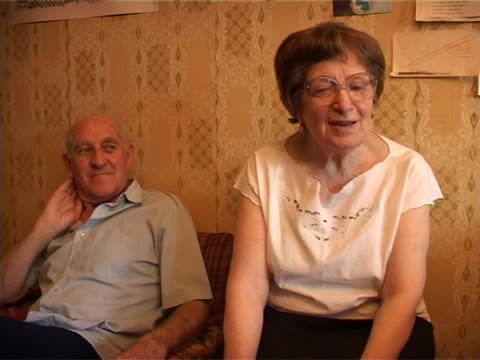
Braverman recalls her Hasidic grandfather's household: bringing the lulav and etrog, the prayers she learned as a child, and Passover customs. She discusses Sabbath breads (kuletsh versus challah) and a favorite baked treat (name uncertain). She remembers her mother's heavy baking work, her grandmother preparing the fish head on Fridays, and her father bringing a carp from the villages. The segment ends with Kerler's question about how the fish was made.
Adds the Passover prayers, the kuletsh/challah distinction and her father's weekly carp.
Braverman describes making gefilte fish, including the stuffed head and the sugar her mother added, and her own borscht with a little sugar. She mentions her first husband, a non-Jew, whose father was of gentry background and who had a Jewish-sounding name. She then answers Kerler's questions about non-Jews who spoke some Yiddish, including a villager called Kuzma, and about terms for gentiles. A story follows about an unbaptized Russian girl. Semyon adds that non-Jews in Zhmerynka spoke Yiddish at the market.
Adds her non-Jewish first husband and his family background and terms for gentiles, beyond food and Yiddish-speaking neighbors.
Semyon Braverman describes the Zhmerynka synagogues and what they became after the war (a club, a bakery, a library, a militia building). His pious father led the congregation and made Yiddish calendars that were mailed across the country. The father's biography, from a Jewish gymnasium graduate, appears in a published book, and Semyon mentions a police fine for an unregistered prayer gathering. Semyon then begins the story of Zhmerynka friends who wrote a letter in 1948 asking to go to Israel.
Adds the fate of the synagogues and the father's Yiddish calendars, beyond family and prewar Jewish life.
Braverman describes how the friends who asked to emigrate were punished with long prison terms, five to ten years. One, a man named Wolf, was blinded in the camps, now lives in Israel and sent him an account of his arrest. He served eight years, until an amnesty. Kerler then asks about Yiddish theater.
Answering Kerler's questions, Braverman remembers the Jewish theater and club in Zhmerynka, which the Jews put together themselves after the war, with singing and dancing. He does not recall a particular play. He mentions that he studied in a Ukrainian school while Jewish children studied in Yiddish, and he mentions a Yiddish school certificate. The speakers then discuss how to film the document.
Faina Braverman shows her tsene-rene, which belonged to an aunt (name uncertain) with inscriptions in Russian. She tells how she first learned Torah as a small child, starting with Leviticus, and Kerler examines a Bible translation she also owns. Semyon's father's calendar leaf and copies of the newspaper Eynikeyt are brought out. Katz and Kerler work out a date from Hebrew letters.
The group looks at a Yiddish school certificate belonging to a friend named Roza, who finished a Jewish school in Zhmerynka. Kerler and Katz read the school and director names (the director's name is uncertain), and the discussion touches on Jewish schools in Belarus. They go through a leaf from Semyon's father's postwar Yiddish calendar, with its holidays, and look at the newspaper Eynikeyt. The interviewers ask whether they may take the originals.