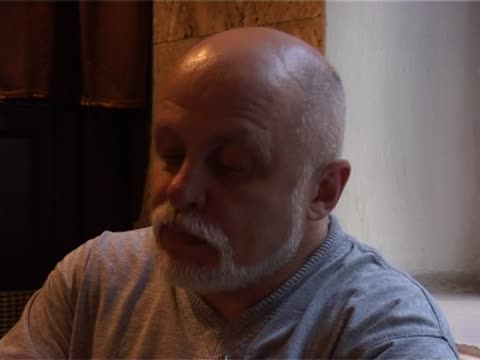
Katz asks in English how far Jewish religious life really survived in the early Soviet period, and Melamed answers in English and then Russian. He discusses the breakdown of the Jewish community after the revolution, early Soviet support for Yiddish culture, the 1926 rabbis' conference in Korosten and persecution of Hebrew, Zionists and underground cheders and yeshivas. He then explains that sources are mostly external, from NKVD and party files, and that he is gathering material for a book on old Zhytomyr. He mentions about 50 synagogues and prayer houses there around 1900, the rabbinical school and Haskalah figures.
Adds the 1926 Korosten rabbis' conference, NKVD archive sources, Zhytomyr's rabbinical school and its synagogues, none of which the catalogue label mentions.
Kerler thanks Melamed and introduces the project, which is recording audio and video with elderly Yiddish speakers, whom he calls the last speakers in Ukraine. He says the team has only two weeks in the region. He asks Melamed to speak about Jewish and Yiddish cultural life in Zhytomyr and the area, and about how he came to his own work and what his plans are.
Melamed says he has no special knowledge of Yiddish, only a passive childhood knowledge, and that he attended a Russian school. He describes his earlier work as a literary scholar, including books on George Kennan and Korolenko and articles on Jewish themes. He describes finding unknown material in provincial archives, such as the rabbinical school's files, and reconstructing about 70 members of Bialik's family. He also describes his work with Project Judaica and his archival guide to Russia, Ukraine and Belarus.
Adds his own literary-scholarly background and publications and the archival guide, beyond the project and work in general.
Melamed describes the language shift across generations: Jews arriving from Poland spoke Yiddish, the next generation was bilingual and his own generation spoke only Russian. His grandparents used Yiddish at home. His grandmother came from a shtetl and his grandfather from Korostyshiv. He recalls a childhood visit to the surviving synagogue and being punished at kindergarten for mentioning it, and the double life of religion in the Soviet period. Later, as a historian, he found official reports on religious holidays and pilgrimages to a tsadik's grave, which the authorities suppressed.
Adds his grandparents' Yiddish, his childhood synagogue episode and Soviet-era surveillance of religion and a tsadik's grave.
Melamed outlines his plans: a book on the Jewish world of old Zhytomyr, a recent article on the early history of the Zhytomyr Jewish community, and a series of archival guides for Ukraine under Project Judaica. He explains why Jewish genealogy is difficult: lost memory under the Soviets, name and registration problems, falsified revision lists and missing records. He says his subjects are mostly the dead, known from gravestones and archives. He says the search interests him more than the results and mentions Natan Eidelman's influence. Kerler asks what drew him to genealogy.
Adds the plans for a Zhytomyr book and guidebooks, the obstacles to Jewish genealogy, Bialik research and the influence of Eidelman.