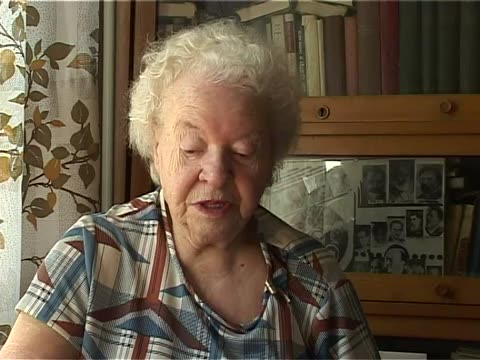
Kipnis talks about her father Itsik Kipnis after his return from imprisonment: his weak health, his arrest and interrogation, and the newspapers people came to read at his home. She describes his three libraries, his love of art albums and of Chagall, his friendships with Ukrainian, Russian and Yiddish writers, and his years in the camps, including a fellow prisoner and a small Jewish group marking holidays. She also mentions his diaries, now mostly archived in Israel, and his heart attacks.
Adds his arrest, interrogation and camp years, and the destination of his diaries.
Kipnis gives personal information: she was born in Sloveshne in 1921, and her mother Simke died five days after her birth. She tells how relatives on her mother's side, including an actor uncle Leybl Khofets (?), refused to take the child and how her grandfather Nokhem and an aunt took her to Sloveshne. She lived with her grandparents until six, when her father took her to Kyiv.
Adds her mother's relatives, the uncle who was an actor, and how she came to be taken in.
Kipnis describes her Yiddish schooling in Kyiv: school no. 33 on Kuznechna Street, where Yiddish writers and her father visited, and later school no. 60, which she attended from the sixth to the tenth class. She recalls teachers including the literature teacher and director, the closing of Yiddish institutions and the school's conversion to a Russian one, and visits to the Yiddish theater.
Kipnis recalls early childhood with her grandparents in Sloveshne. Her grandfather, a moderately observant man, made her carry his prayer shawl to synagogue on Sabbaths, which embarrassed her as a Pioneer. She also mentions children's games and songs in the courtyard, and begins to speak of her father's centenary in 1996 (?).
Kipnis recounts attending events marking her father's hundredth birthday in America, where she spoke and a woman recognised her as a childhood playmate from Sloveshne. She then mentions her father's friendship with the Yiddish poet Moyshe (?) Shapira, who died young, and whose son fell in the war.
Kipnis speaks about her grandparents: her grandfather was a tanner who prepared hides, and the family's workshop was later taken by the Soviets. Her grandmother kept house, livestock and poultry and cared for the grandchildren, and visited Kyiv only briefly because she missed home. The grandfather stayed behind under the Germans and was killed in 1941. The segment ends with Kerler promising to return.
Kipnis names foods her grandmother made, such as buckwheat latkes and a Sabbath kugel, and answers a few questions about words such as the grandmother's name, the word for a cross, and for nursing a baby. She is asked whether she recalls certain words, and says her Yiddish was praised as better than that of Polish Jews. The exchange is informal.
Kipnis tells of seeing off her father's youngest sister's family to Israel at the Kyiv airport, where her relative danced and made merry. The year is given as 1971 (?).
The segment is a story about emigration to Israel rather than life today.