0:00
Empty.
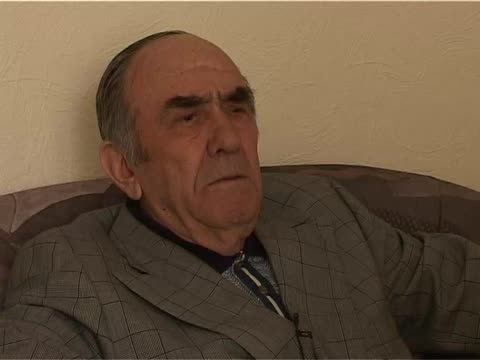
One conversation with Iosif Volkovich Torchinsky, continuing over MDV 503, MDV 504.
Empty.
Formal introduction.
Kerler opens with a spoken introduction to the expedition and its aim of recording Yiddish memories from older speakers, then collects basic data. Torchinsky gives his birthplace as Skvire, his birth date in 1918 and his official name Iosif, and Kerler asks for his address and telephone number.
Formal introduction and family.
Torchinsky gives his Yiddish name from home, which he says was changed to Iosif in the official documents, and says he lived in Skvire until 1934 before moving to Kyiv to his older sister Manye. His father died when he was a year old, and he was told his father had been a soldier or some craftsman. His mother Sore worked in a small shop. He discusses his sisters Manye, who was killed with the mother at Babi Yar, and Freyde, now in Israel, and begins to speak of the Yiddish school that he finished in 1933.
adds the Yiddish name and the question of the father's origin and the mother's name.
School education and Red Army service.
Torchinsky recounts finishing the seven-year Yiddish school in 1933, moving to Kyiv in 1934 and being drafted into the Red Army in 1938. He was then sent to a military school in Odesa and became a political worker. He married in March 1941 and lived with his wife for three months before the war began and she was evacuated.
Childhood memories and family.
Asked for his earliest memories, Torchinsky describes the Jewish town of Skvire with its synagogue and prayer house and the preparation for Passover. He recalls going to synagogue with his grandfather on Simchat Torah when he was about six, and discusses whether his grandfather could read Yiddish or Hebrew and the term for the holy tongue. He tells of his uncle Shmilik's attempt to take him to Palestine in 1924 and his running away to stay with his mother, and of his childhood pranks of stealing unripe fruit from a garden and throwing bread into the Passover borscht.
adds the grandfather's literacy, the uncle's invitation to Palestine and the pranks.
Religious education.
Torchinsky tells how a teacher came to his home to teach him the Hebrew alphabet instead of attending cheder, and how he mocked the teacher. He recalls the teacher's punishments and one incident in which the teacher chased him. The name of the teacher is not remembered. Toward the end there are Russian asides in the room and a brief mention of the grandfather's name.
Yiddish literature and family.
Torchinsky discusses a mischievous child, as in Sholem Aleichem, and how he too was a prankster, growing up without a father with his widowed mother and two sisters. He says his grandfather, perhaps a carpenter, gave them a small part of his house. He recalls how the relatives in America sent 25 dollars so that his mother could buy proper flour for Passover latkes, and that the flour was stolen at night, in the mid-1920s.
adds the Sholem Aleichem comparison and the grandfather's trade.
Passover celebration.
Torchinsky continues with the story of his mother buying Passover geese from a peddler, and how his family was cheated with the geese. Kerler compares the story to a literary one. Torchinsky then turns back to the Yiddish school he started in 1926.
School education.
Torchinsky describes the Yiddish school in Skvire, school number two, and his first teacher, with an excursion by the river on which he played a prank. He mentions the Yiddish wall newspaper, his learning printed lettering, and drawing banners for Soviet holidays. He names the director Fishman, a geography teacher, and a letter episode involving the director's son. He recalls Yiddish literature taught, including Mottl Peyse by Mordkhe(?) and Itsik Fefer, and recites lines of verse. He reads a poem written as a school pioneer, and notes he went to a Ukrainian technical school in the 1930s.
adds the director Fishman, a school letter episode, and recited poetry.
Kolkhoz.
Torchinsky tells how his mother, after her trade was liquidated, joined a Jewish collective farm and worked as a cook and later in the fields. She suffered from Parkinson's disease. He describes the move to Kyiv in 1934, helped by friends, and working at a repair factory. His sister Freyde came too and worked as a planner at the factory after a technical course in Kharkiv. He then moves to his army service from 1938.
Red Army.
Torchinsky repeats that he graduated from the military school in Odesa, became a political worker and married Manye (Maria) in March 1941, who is from Pereiaslav. Kerler corrects the length of the marriage to three months and asks about the poem he plans to read.
Reading his poems.
Torchinsky reads his own poem to his wife, written in the 1980s for her jubilee, about their meeting in Pereiaslav, three months of marriage and separation in the war. Another poem reads as a letter from the front in Bessarabia, mentioning being wounded in 1942. Kerler and Torchinsky then discuss her name, Mariam, Maria and Manye. Kerler asks to hear about how he became a teacher.
Religious life and education.
Kerler asks about synagogues in Skvire, and Torchinsky names a prayer house kept by a yeast maker and cantor. He describes a recent visit with American rabbis and Hasidim to Skvire, where he said Kaddish at the site of his father's grave and found nothing left of the cemetery. Kerler asks for Yiddish terms for the cemetery, such as holy place and good place, and explains their meaning. He answers whether the tutor taught him the morning prayer Modeh ani, and comments in Russian.
adds the visit by American Hasidim and Kerler's questions on terms for the cemetery.
Sabbath celebration and cultural life.
Torchinsky answers Kerler's questions about his mother lighting Sabbath candles, Sabbath dishes, and what was brought at Purim. He says no one else in the family blessed the candles. Asked about anti-religious campaigns at school, he recalls a printed play against Passover that the school performed. He also recalls a girl who sang and later went to Israel, and says there was no theater in Skvire, only visiting performers and a drama circle.
adds Kerler's questions on Sabbath and Purim customs and the anti-religious school play.