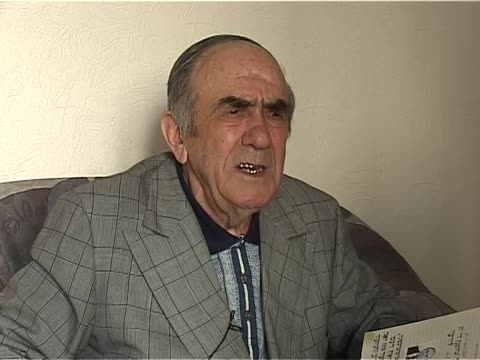
Answering Kerler's questions, Torchinsky discusses the anti-religious school play about a spoiled Passover, staged for pupils at the Skvyra Yiddish school in the mid-1930s (year not clear). His family disliked it, and his grandfather wanted to take him out of school; he was a pioneer and did not ask the questions at the family seder. He describes Seder food his mother prepared (borscht, chicken soup, matzo-meal dishes) and answers questions on terms for gefilte fish and its pepper flavouring. Kerler tells an anecdote about his own father, and Torchinsky begins to announce a poem about Ukraine.
Torchinsky explains what the expression 'a gutter yid' (a good Jew) means: an honest person who shares his bread, as opposed to a bad Jew. He then reads his poem about Ukraine as his homeland, written in 1989 (as heard; possibly 1988), after which Kerler praises it and returns to the question of the taste of his mother's gefilte fish.
The tape's passage includes an explanation of 'a good Jew' and the recitation of the poem.
Kerler puts questions on food terms (sour, sweet-sour dishes, tsimes and why it is made, latkes, chopped versus stuffed fish) and on the word 'Galitsianer'. Torchinsky then tells how the Sunday Yiddish school in Kyiv was founded, and shows the camera a newspaper clipping about it. Its president Levitas asked him to teach there, and Torchinsky was hesitant because of his limited schooling and decades without using Yiddish. A friend, the poet Yosl Bukhbinder, encouraged him. He later wrote a reader and poems, some printed in Birobidzhaner Shtern and Sovetish Heymland.
Besides food customs, it covers the founding of the Sunday Yiddish school and Levitas's invitation to teach.
Torchinsky reads his poem about the Warsaw ghetto, dated 1992. It describes the German conquest, deportation, killings, burning of victims, and the uprising and the hope of liberation. Kerler then says he has a few questions and asks about non-Jews who spoke Yiddish.
Torchinsky recalls non-Jews who spoke Yiddish, whom he met later in Kyiv: a Christian woman who worked for Jews, and her sister. Kerler notes there were no non-Jews at his Yiddish school in Skvyra. Torchinsky mentions Ukrainian students now learning Yiddish and recites his 1994 poem on the Yiddish language, the mother tongue, and the decline of Yiddish schools. He appeals to the American visitors for advice, and Kerler encourages him and moves to a question about the difference between babke and kugel.
Questionnaire on food and drink words with Kerler: kugel and babke and their ingredients, rasl (brine or juice), tomatoes, baked goods and pastries, strudel, flodn, kamish bread, evening meal, and the word for vodka (bran(t)fn). Torchinsky says Jews drank brandy on Simchat Torah and Purim but not wine, and that vodka was not drunk on Passover. Kerler also asks about 'dibek' (a bad person) and 'goylem' (golem).
Beyond food customs, includes drinking customs by holiday and the terms dibek and golem.
Answering Kerler's questions, Torchinsky recalls the prewar synagogue and bes-medresh in Skvyra, where only men went to pray and women sat apart, and describes praying there with his grandfather. Kerler asks about klezmorim, wedding customs and a place name (apparently 'tsvinter'). He continues with expressions used when mentioning the dead and then with greetings, thanks and congratulation, the word for stomach and for book, and the difference between 'sick' and 'sleepy' (the transcript is unclear on some of these). Torchinsky mentions his own Yiddish-Ukrainian dictionary of six thousand words and begins to read another poem, about Passover and the Exodus.
Besides religious life, includes elicitation of formulae for mentioning the dead, greetings and thanks.
Torchinsky reads three of his poems. The first is on Passover (dated 1992), retelling the Exodus from the baby Moses to the crossing of the sea and the seder. The second is devoted to Sholem Aleichem and his museum in Pereyaslav (the transcript does not give the year). The third, to Yiddish-learning children, is dated 1990. Kerler brings him back after the first poem to the seder at his grandfather's, and S2 and the Russian asides note the recording and technical details.
Gives the order and content of the poems on Passover, Sholem Aleichem and the children.