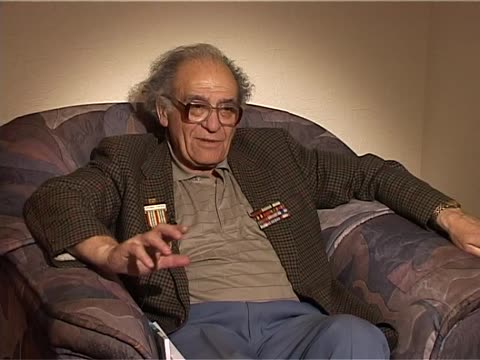
Khandros talks about his genealogical research in archives, where he is brought bundles of documents, including Russian-language census-type records from Ozarinets. He explains that Jewish children were named after grandparents (himself after his paternal grandfather, his brother after his maternal one), which let him trace his great-grandfather and his children. Kerler comments on the value of this naming custom for Jewish genealogy.
Gives details of the archival documents and the naming custom.
Kerler fills in the interview form: the town is Ozarinets, which administratively belonged to Kamianets-Podilskyi province before the Revolution and later changed district, and Khandros considers speaking some Russian as well as Yiddish. Kerler notes the date and that it is the second expedition. Khandros explains his Russian name Boris Naumovich Khandros, shared with his brother, whose Yiddish name was Berl while his own is Barukh. His father was Nakhman Moshe, and he says the family's own history is interesting but long.
Covers the naming of him and his brother in school and army, and the brother's grave.
Khandros gives his birth date and those of his parents, who were both born in Ozarinets; his father was a melamed until 1922 and then became a teacher and head of a Yiddish school, where Khandros studied for four years. His mother Mintsi was his father's pupil and later a teacher too. He names his brothers (one the younger Berl, born 1926, and Hershele, now a mathematics teacher in a Ukrainian town) and a sister Sarah who died in 1988 (?), all of whom went through the ghetto.
Gives the parents' ages and the siblings, including a brother alive now, and the sister's fate.
Asked about the ghetto, Khandros says he was in the ghetto and in the Pechera camp and escaped from it, and that he was shot at and wounded. He refers to his published book for the full story. He speaks of five people who saved him at different times and are honoured at Yad Vashem, whom he regards as his own family, and offers to show photographs.
Khandros says he finished tenth class in Ozarinets in 1941, after four Yiddish classes, then Ukrainian school. He recalls the graduation evening and fishing with a friend when the war began. He later taught briefly after the war and, before the war, worked as head of the school library.
Mentions that he worked briefly in a school after the war.
Khandros describes the school library he ran as a splendid cultural centre where young people met and discussed. His father's Yiddish school was famous in the area and was the last Yiddish school in Ukraine, closed in 1945. Until he was eight he knew no Russian, only his mother tongue and the many Yiddish folk songs his father knew.
Adds the language of his childhood and the father's repertoire of folk songs.
Khandros sings parts of Yiddish songs his father knew, including one about a hammer and one about ringing bells. He says his father sang at family gatherings until about ninety-three and that he recorded his father's voice from 75 on, offering to let Kerler hear the recordings. He also mentions the school library and the many books his father loved.
Includes the recordings of his father and the singing of two songs.
Khandros recalls a Yiddish library at home: his grandfather's old cabinet held Talmud and other books. His father studied with his own father, knew Hebrew well, and was more devout than the grandfather, who had been a cantonist and came from Chernobyl. Kerler asks about the generations in Ozarinets.
Adds the home library, the father's Hebrew learning and the grandfather's cantonist background.
Khandros relates how his grandfather, from a family of melamdim in Chernobyl, was orphaned in an epidemic, was taken as a child by cantonist recruiters and served in the army for many years. Afterwards he studied in Zhytomyr, and Khandros tells why he came to Ozarinets: as a boy he had been a friend of a tsadik's grandson of the Twersky dynasty, who later became the tsadik of Ozarinets. Khandros discusses the tsadik's grand wedding and says he will tell more in the third part of his book. Kerler also asks whether the Russian term for the Pale of Settlement existed in Yiddish.
Adds the grandfather's cantonist army service and the question of a Yiddish term for the Pale.
Kerler asks about the Ukrainian word for a unit of weight (pud) and Khandros says Ukrainian uses the same word; they also discuss a word for a dove. Khandros then begins on the origin of the name Ozarinets, mentioning his father's older friend, a brilliant teacher named Krevitsky.
Khandros explains theories of the name Ozarinets, which an older teacher derived from a lake, though he now thinks it comes from the word for bazaar. He recalls the fairs held in the town until the late 1920s, twice a year, with peasants coming from many villages and separate places for selling cattle, pigs and clay pots, and Jews earning a great deal in three days. Kerler then asks him to recall his childhood between ages three and six.
Adds the etymology of the town name and the fairs' details.
Khandros says the fairs ended with collectivisation, then shows articles and a book on the famine by a Ukrainian writer and a Russian one, complaining that he has never been invited to conferences on the Famine because he is a Jew. He praises his father, who was so loved as a teacher that his name alone sufficed in the village. He reads, in Russian, accounts he recorded from a widow in 1988 about the village where documents survive and about a death in 1933, mentions his two films and his writings, and says most pieces are about 1933.
Adds his father's reputation and the Russian passages he reads aloud.
Asked for memories of the Great Hunger, Khandros describes documents and a letter from Berdychiv in which a Jewish factory worker, who later died, begged for help, and he says it shows that Jews starved too, against claims that they did not. He discusses the Torgsin shops, where gold was exchanged for flour, and how his mother's gold was broken into three parts. He relates a butcher's story about gold and a hiding place, the mobility of Jews who could travel to Moscow and Leningrad, and relatives in Leningrad who sent rusks. He describes death registers from 1932–33, deaths from eating in summer 1933 and a dysentery epidemic which he survived because his uncle kept him at home instead of sending him to hospital. Kerler remarks that many informants deny Jews died, and Khandros reports letters in Russian that deny the famine.
Adds the gold and Torgsin themes, uncle's help, and debate over whether Jews died.