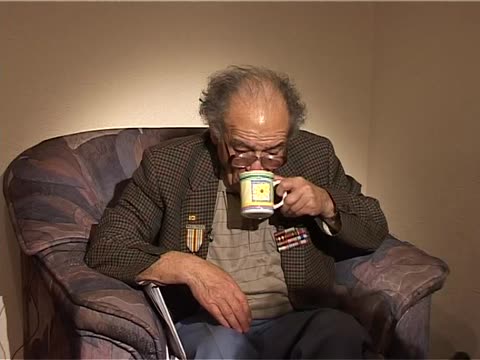
Khandros talks about the poet Shloyme Roytman, secretary of the Yiddish section of the Soviet Writers' Union. Kerler asks about his role. Khandros says Roytman's brothers were shoemakers in Mohyliv, where Roytman survived hard months, and that Khandros organised an evening about him there. He then turns to his own army posting after the war, which brought him to Grabovets and Bialy Wody.
Also covers Roytman's family of shoemakers and his survival in Mohyliv.
Khandros recalls his service as a commissar in a cavalry regiment, quartered in the park of an estate at Bialy Wody in summer 1945. He describes the ruined town of Grabovets, where pavements were laid with Jewish gravestones, and a local priest who told him the history. He tells how he found a cellar with Jewish belongings and the names of an owner, his wife and two children, shot for hiding Jewish families. The Ukrainian police were alerted by a neighbour. Kerler establishes that this was summer 1945.
Gives details of the destroyed town, gravestones used as pavements, and the family shot for hiding Jews.
Khandros describes how he experienced the end of the war: 1 May 1945, with the cavalry advancing toward the Elbe, German equipment and scattered newspapers, and his first hearing grass grow. He heard the Berlin radio announce Hitler's death. A friend who rode ahead to announce the German surrender was shot by a German. Khandros explains a term from the interrogation of prisoners, with Kerler asking about a word, and says he served as German interpreter.
The end of the war is set near the Elbe, with the death of a comrade and German interrogation work.
Asked whether he studied German before the war, Khandros describes his village school, where German teachers were intermittent. In the tenth class, in 1940, a young Komsomol member with only a few months' training came to teach it. His father also wrote out the paper Rote Fahne for him.
Khandros talks about a poem he read in Rote Fahne, a Moscow newspaper for children in German, which became a key to his later life. He mentions Heine. He talks about his decade of work on a Soviet council for aesthetic education and his teaching in an evening school. He speaks about Yiddish writers' descendants who cannot read Yiddish, including a grandchild of Sholem Aleichem whom he visited in New York. Kerler asks about Yiddish terms and then redirects the interview toward Khandros's memories.
Also covers Heine, the descendants of Yiddish writers and the decline of Yiddish.
Khandros and Kerler turn to the Yiddish school in Ozarintsy and the teachers. Khandros says his father attended courses in Kyiv in 1926 with the Reznik brothers, Lipe and Yoyse, and that the writers Lipe Reznik and others visited in 1934. The school ran from 1922 to 1945 and was the last one left. He recalls his grandmother Sure, his own illness at that time and the first time he saw writers. He also mentions his grandmother Miriam and the loss of Yiddish schools in the Vinnytsia region. He ends by mentioning the Black Book.
Adds details of the Reznik brothers, the 1934 writers' visit, the school's closure and his grandmother Miriam.
Khandros speaks about the Black Book of the Holocaust. He says he wrote a letter to Ilya Ehrenburg about a friend from Lviv that was printed in the collection on the murder of peoples. Kerler notes that he will look for his own family name there. Kerler then asks about his grandmother Sure.
Khandros talks about his grandmother Sure, who died in 1935 and knew Yiddish literature well. She was from a family from Snitkiv, daughter of David Grinfeld; her first husband was a friend of Goldfaden; her second husband was Berl Vaynshtok, Khandros's mother's father. He recalls her love of the written word and his other grandmother Miriam. He describes a fire in the house, and an incident in which his baby brother nearly drowned at a mill. He also mentions the mikveh.
Gives grandmother Sure's family background and two childhood memories.
Khandros talks about his father's religiosity, from fanatical devotion to a turn toward freethinking. He recounts that his father was denounced for attending synagogue while a Soviet teacher. He describes the rabbi in Ozarintsy, Gedalye Roytberg, who was learned, and the church built in the 18th century by Polish magnates, which closed in 1931. He recalls the Poles, Ukrainians and Jews in Podolia. The Yiddish writers read at school are named.
Adds the story of the denunciation to the district, and the church and mixed population of the town.
Khandros names Yiddish and Russian writers he read at school and later, and quotes a poem of Usher Shvartsman. He tells how he and his wife, both journalists, visited a Russian poet in Leningrad. He describes the Ukrainian teacher Alexei Krevitsky, who organised the Ukrainian school. Krevitsky mentored Khandros's father in ethnography and folklore, and the ethnographic circle of 1926 in Ozarintsy. A Ukrainian ethnographer's expedition to the town gave him a view of his shtetl from outside.
Includes the recited poem and the Ukrainian ethnographer's expedition to Ozarintsy.