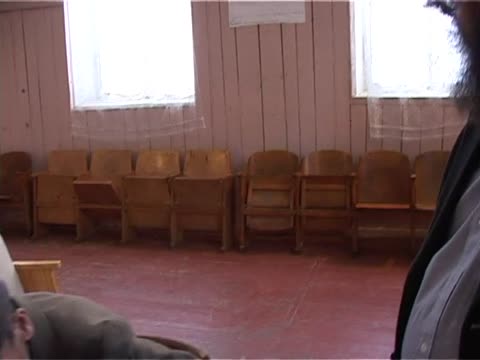
This tape consists of a formal interview with David (Duvid-Hersh, or sometimes Duvid-Tsvi when called up to the Torah) Abramovich Vider (b. 1922 in Sighetu Marmatiei). He provides Professor Kerler with a brief tour of the synagogue and a look at its old Torah scrolls, and discusses Kolomyya’s contemporary Jewish religious community. Vider talks about his traditional religious education in a yeshiva, where he learned to speak Hebrew. Vider’s father Avrum-Mayer worked many jobs as a shoykhet (kosher butcher), melamed (religious teacher) and a khazn/bal-tfile (cantor and/or prayer leader). Vider states that he remembers all the prayers and liturgy he learned. He briefly describes how he and his father once led Simkhes-Toyre (Simchat Torah) celebrations together. Vider then shares his and his family’s basic biographical details. He was born in the town of Sighetu Marmatiei, moved with his family at the age of three to Hîrlau, and then moved again around the age of twelve to Iași where he attended yeshiva.
From the machine transcript
Greetings and introductions at the synagogue in Kolomyya, then a short look at the synagogue: Vider says few Jews are left, that a minyan is possible mainly on holidays and sometimes on Sabbath, and that there are two old Torah scrolls. He mentions the community's prayer leaders and his own study of Hebrew in yeshiva in Hîrlău and Iași, and his father's work as shoykhet, teacher and cantor. He gives his birth in Sighet in 1923 (?), the move to Hîrlău at three and to Iași at about twelve, his family name and double name, and his father's name Avrum-Mayer, and he states his address and telephone number. At the end he begins to talk about going to Russia.
Also covers his names, family names, address and telephone, and the grandfathers' names.
After some audio and logistical problems, Vider continues, explaining that he moved to Russia in 1940 without knowing any Russian. At the age of eighteen, he began working in a mining town in the Urals and then worked for some time as a mechanic in the Garagum (Kara-kum) desert in Turkmenistan, where he earned a decent living, but hated living in that area. After that job, he worked in a mine in the L’viv area, staying there until the age of seventy, at which time he retired to Kolomyya, a town he had visited often as his sister lived there. Vider learned how to cook and bake a whole repertoire of traditional Jewish foods from his sister, and he shares a recipe for chicken liver.
From the machine transcript
Vider recalls moving to Russia in 1940 without knowing Russian. He worked in a coal mine in the Urals from about eighteen, spent years as a mechanic in the Karakum desert in the heat, and then worked in a mine in the Lviv region until retiring at seventy. He retired to Kolomyya, where his sister and brother-in-law lived and died, and where he learned cooking and baking from her; he describes how he prepares fish and fills a chicken neck, and remembers his parents' cooking and his father's Sabbath challahs.
Adds his mother's and father's cooking and baking and his siblings' deaths.
Vider returns to the subject of his family life before he moved to the Soviet Union, richly describing shabes (Sabbath) and Passover celebrations, as well as his five siblings’ life stories.
From the machine transcript
Vider describes the Sabbath and Passover at his parents' home before he left: the candles, kiddush, the challahs, the father seated at the seder, and the four questions, with poor guests staying over. He names his brothers and sisters, their fates and nicknames, including a brother killed in Palestine and a father and another brother shot in 1940 (?). He also talks about cholent kept in the oven and about kugel, for which Kerler asks the Yiddish word.
Adds the siblings' names, the seder, and the kugel/babke terminology question.
Vider shares his recipe for tshulnt (cholent, slow-cooked shabes stew) and discusses shoykhtim (kosher butchers) and the different kinds of meat dishes, including pastrami and geese that they would prepare.
From the machine transcript
Vider tells what went into the Sabbath cholent and speaks of the kosher butchers and slaughter in his hometown, including separate shoykhtim for poultry and for cattle. He recalls a Jew who fattened geese and made pastrami and smoked meat, and describes how he now prepares meat himself, stuffing it with garlic and pepper; Kerler asks for the Yiddish word for the bread box.
He sings a loshn-koydesh (the Hebrew-Aramaic "holy tongue” of prayer and liturgy) song that he learned while a student in the Beys-Arn Yeshiva. He describes the yeshiva’s teachers and curriculum, and recites some of the Hebrew grammar and verb conjugations that he remembers. Vider also explains the difference between a "rebe” and a "ruv”.
From the machine transcript
Vider sings a Hebrew song from his time in the Beys-Arn yeshiva in Iași and talks about its teachers, naming a rebbe (the name is uncertain in the transcript), and about the modern Hebrew he studied, reciting some grammar and verb forms. His sister later tried to study Hebrew in Palestine. He then explains the difference between a rebbe and a rov: a rov is asked questions of law, such as whether an animal is kosher, while a rebbe is a Hasidic rebbe.
Adds the rebbe/rov distinction and his sister's attempt at Hebrew studies in Palestine.
Growing up, Vider was a khusid (Hasid, follower) of the Botoshaner Rebbe who lived in Iași. He and his family would go to the Rebbe for the high holidays. Vider studied for three years to become a tailor, but he did not enjoy the work, so he moved to the Soviet Union, where he thought he could earn a better living.
From the machine transcript
Vider says he was a Hasid of the Botoshaner Rebbe in Iași and went to him for the High Holidays and for selikhes, and took part in prayers there. After the yeshiva he trained three years as a tailor in Iași, disliked it, and left for the Soviet Union. He also recalls working as a tailor during the war and sharing bread with hungry people.
Adds the wartime bread-sharing episode.
Vider further describes the court of the Botoshaner Rebbe in Iași, detailing the baking of matzos and making of wine there. Vider then shares a fragment of the Rebbe’s "nign” (wordless melody) and sings a special "shir hamaloys”. Vider states that he used to sing this song and others when he went fishing and that is how he has remembered everything.
From the machine transcript
Asked by Kerler, Vider describes the Botoshaner Rebbe's court in Iași, with its garden, the baking of shmure matzo before Passover and the making of wine in autumn. He begins to sing one of the Rebbe's melodies and says he remembers other niguns; Kerler asks to hear more.
Adds the wine-making detail.
"Shir Hamaloys” (Song of Ascents).
From the machine transcript
Vider sings a Hebrew Psalm-like song, probably a shir hamaloys, in a long stretch of sung Hebrew that the transcript renders poorly. Afterwards he explains that he remembered such songs from his years in Chervonohrad, where he went fishing on the river Buh by bicycle, singing as he rode. Kerler then asks about Sabbath zmires.
He sings fragments from several shabes zmires (paraliturgical songs), including "Ko ribon,” and "tsur misheloy”.
From the machine transcript
Vider sings brief fragments from the Sabbath songs (zmires) in response to Kerler's questions, saying he remembers a lot but that his memory is going. He says he is now eighty-something.
Vider talks about his prewar family life, focusing on his mother and father’s work, the family house in Hîrlau, and that town’s geography. He comments on the Yiddish dialect differences in the places he lived in his youth, and speaks about Kolomyya’s synagogue and contemporary Jewish community. Vider reports that he reads and writes in Yiddish. He shares his attitudes towards different dialects and talks about different people in Kolomyya with whom he speaks in Yiddish.
From the machine transcript
Vider speaks about his mother as housewife and his father's work, and about the family house in Hîrlău, which was washed away in a flood, and his father's business as a forest leaseholder. He compares his Transylvanian Yiddish to what he met in Iași, says he reads Yiddish and had a fine Yiddish script, and discusses Kolomyya Jews who speak Yiddish and the Podolian visitors' speech. The passage ends with Kerler asking about a Kolomyya man named Greif, born there, and the telephone numbers of local Yiddish speakers, and then returning to the Rebbe's court.
Adds the Yiddish speakers of Kolomyya and Kerler's search for a local-born speaker.
Vider discusses his family relationship with the Botoshaner Rebbe, noting that he officiated his sister’s religious wedding. He also speaks about Jewish weddings and match-making in general. Vider also shares his memories about the Rebbe’s wife, family and court, and mentions that his mother’s cousin, Reb Mayer was a khazn (cantor) and tsadik (righteous holy man).
From the machine transcript
Vider tells how his parents, before they were married, were brought to the Botoshaner Rebbe, who gave them a religious wedding, while the civil registration was done separately. He says he was too young to remember Jewish weddings or a badkhn well, and recalls matchmakers, the Rebbe's gabbai and payments and gifts to the Rebbe. He tells of a cousin of his mother, Reb Mayer, a cantor and righteous man who owned a mill and was paid well for singing in Iași, and of the Rebbe's wife and three children, whose names he gives; he cannot recall the Rebbe's full name.
Adds the Rebbe's wife and daughters' names and the gabbai's fundraising.