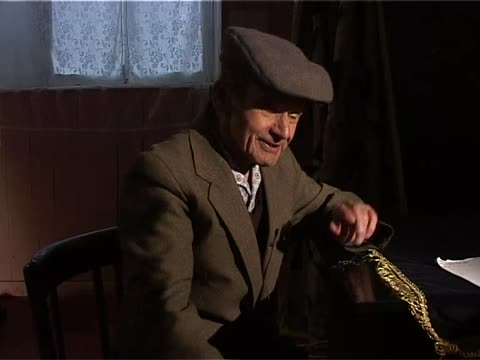
Vider answers questions from Professor Kerler’s sociolinguistic and dialectological questionnaire. He also speaks about how his mother made "khale” (special bread for the Sabbath).
Answers Kerler's questionnaire items on the Yiddish word for a Romanian-borrowed term ("mult"/"mai mult"-type words for 'more'; Romanian equivalents are discussed), and on the parashah of his bar mitzvah, which he does not remember. He then describes how his mother baked challah in Hîrlau and Iași: the Thursday-night dough, the braiding on Friday morning, the blessing and the piece thrown in the fire. He mentions the outdoor oven and cholent put in it.
The elicitation also covers a Romanian equivalent and the bar mitzvah portion, and the mother's baking is placed in both Hîrlau and Iași.
Vider describes holiday observances in great detail, focusing first on Rosh Hashone, Yom Kippur and the recitation of slikhes (penitential prayers) done during that season. He also explains how sikes (Sukkoth, the Feast of Tabernacles) was celebrated and sings part of the "hoshone robe” services he remembers, comparing these observances to contemporary celebrations of the holiday. He also talks about how Chanukah and Purim were celebrated and the food and games that went with this respective holidays.
Vider answers Kerler's questions about the Jewish year as he remembers it from Hîrlau: the days before Rosh Hashanah and Yom Kippur with slikhes, going to synagogue with his father, the pre-fast meal, tashlikh, and shmura matzo baked at the rebbe's. For Sukkot he describes the sukkah and its roofing, the etrog and lulav, and the hoshana rabbah/Simchat Torah hakafot, singing a few lines. He then speaks of Hanukkah candles, songs and money, and foods for Hanukkah and Purim (latkes, pancakes of potato or flour, krepl), and the dreidel.
Also covers the food terms (latkes, panchikes, krepl, ripleniks) and the baking of potato dishes in an earthen pot, with Transylvanian origin of some terms.
Vider explains "shpiln in nis,” a gambling game involving nuts played by children during Passover and Sikes (Sukkoth). Vider talks about the different dairy food eaten during shvies (Shavuot) and shares a recipes for "plitnikes” (a sort of blintz).
Vider explains the children's nut game played in a hole during Passover and Sukkot, including the eight-nut rule for the stakes. Asked about Shavuot, he says only dairy dishes were eaten, among them blintzes, which in Hîrlau were called plitnikes (the word is repeated and checked). He gives a detailed recipe: batter of flour and milk with salt and oil, poured thinly in the pan and turned like a pancake, and filled with cheese.
Vider shares his attitudes towards different dialects of Yiddish, and mentions the many Yiddish-speaking non-Jews he met both in Romanian and the Garagum (Kara-kum) desert in the Soviet Union.
Vider talks about Yiddish dialects and accents, including how Jews and non-Jews spoke it. He recalls Romanian non-Jews in Hîrlau who spoke Yiddish, such as servants in Jewish homes, and a Polish Christian cook whom he met in Yiddish-speaking circles. He also mentions actors, apparently on Russian-language stage and screen, who speak Yiddish-like speech. Kerler asks whether he spoke differently at home.
Adds a remark about the speech of actors, apparently Russian-language stage and screen performers, and the specific Polish woman who spoke Yiddish.
Vider recalls the local and visiting Yiddish theater troupes and circles in Hîrlau. He also describes the Yiddish and Romanian-language newspapers that were read in his youth and discusses Jewish interactions with Romanian anti-Semitic and fascist organizations in the prewar period. He mentions that there were many Zionists group in the towns in which he lived, including Gordonia (of which he was a member), and Shomer HaTsa’ir and Makabi (to which his brother belong). Vider then tells the short story of how his brother emigrated to Palestine after the war.
Vider recalls Yiddish children's theater in a cellar and school festivals in Hebrew, Yiddish and Romanian in Hîrlau, then visiting cantors and an actors' club (the Dybbuk is mentioned). He talks about Yiddish newspapers, one of them illegal, and about the Cuzist (Cuza/Codreanu) antisemites who in 1939 (?) wanted to burn synagogues and whom Jews resisted. He says he belonged to Gordonia, while his brother was in Maccabi and later Betar and a chalutz who could not emigrate until after the war.
Adds antisemitic Cuzists and Iron Guard-type groups, children's cellar theater, and the brother's emigration.
Vider briefly discusses the Jewish bathhouse in his shtetl that was used as a mikve (ritual bath) by the town’s men on Friday night before shabes. From this topic, Vider and Professor Kerler discuss the origins and uses of the idiom "firn in bud arayn” (lit. "to lead somone into the baths”). Vider reminisces about the nignum (traditional wordless melodies) sung by his Rebbe. He then sings a loshn-koydesh (the Hebrew-Aramaic language of prayer and liturgy) song that his father would sing at the third meal before the end of shabes.
Vider and Kerler discuss the bathhouse with its mikveh in his town and the idiom about leading someone into the bath, which Vider explains as meaning that someone who is not pleasant gets no good treatment. Asked for a wordless niggun of his rebbe, he does not recall one. He sings a Hebrew song his father sang at the third Sabbath meal in the synagogue, beginning with the line "Yedid nefesh"-type text, followed by a few words on a sentence Kerler elicits about the word rov.
The transcript shows the explanation of the idiom and a song actually sung by Vider after attributing it to his father, with lines mostly garbled.
Vider answers Kerler's questionnaire on plural forms of rov/rebbe (rabonim, rebbes) and on the Yiddish term for a good place as a euphemism for a cemetery. He says a cemetery was called a holy place or house of life. They then discuss the word Litvak, Lithuanian Jews and their Yiddish pronunciation, an anecdote about a Lithuanian youth praying in a local synagogue, the word misnaged, and whether he had heard of the Vilna Gaon and the Baal Shem Tov.
Vider reports that he read a good deal of Yiddish literature in his youth in Romania, as his mother had poor vision and he would often read aloud to her. Vider’s mother was a "firzugerin” (women’s prayer leader) in the synagogue, and he describes how the women used to pray.
Vider says he read a good deal of Yiddish in his youth, such as Mendele Moykher Sforim. His mother's eyesight was poor, so he read to her. His mother was a leader of the women in the synagogue, the firzogerin: she read the tkhine aloud on holidays and the women cried. He describes the women's section and the praying.
Vider also names Mendele as one of the authors he read; the mother's eyesight is mentioned, but later (s0010) he disputes it.
Professor Kerler and Vider return to the sociolinguistic/dialectological questionnaire. Vider also details how he mother cooked and shares his recipes for "gefilte fish” and other foods.
Kerler returns to the questionnaire (the word Galitsianer, and Galicia as then and now Halych) and then asks about Vider's mother's cooking. Vider describes making gefilte fish from pike and carp in detail: choosing fish, onions with sugar and soda, the skin and bones used for the jelly, and his remark that he learned to make it himself. Kerler also asks about petshe (calf's-foot jelly) and about the term brezl (sukhariki).
Also covers questionnaire words (Galitsianer, brezl, petshe) and the story of cooking gefilte fish for a woman who did not know it.
Vider answers Kerler's questions about the Yiddish books he read: Mendele's Fishke der krumer and other works, which his father also read aloud, Sholem Aleichem, Shmuel Gordon's booklets after the war, and Peretz. He says he took books to the mine, and that Sovetish Heymland came after the war. He adds that after the war he was afraid of the Communists and did not keep a siddur at home. Some details about his mother's eyes are contradicted by Kerler's question.
Vider tells the story of how he learned to speak Russian and, on a related note, how he became a miner in the Soviet Union, in addition tot he other jobs he held. Vider answers further questions from Professor Kerler’s sociolinguistic survey.
Vider tells how in 1940 (?) he crossed the border and in Kizel, a mining town, was left alone in the house by a woman who traveled to Belarus. A neighbor, a pharmacist, asked him to alter a coat, and in exchange taught him Russian from a primer, so that he learned to read and write. He worked for ten years in the mines, then did many jobs, including locksmith, carpenter and electrician. Kerler asks questionnaire words from this time: the word for a quilt or bedspread, Yiddish zikhl/tikhl, tvarik, and the residue left after making butter.
Adds the questionnaire items at the end, about terms for bedding and the byproduct of butter making.