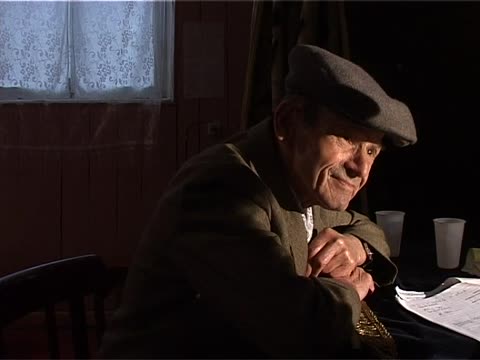
This tape is a continuation of a formal interview with David Abramovich Vider (b. 1922 in Sighetu Marmatiei). It begins with the interviewee answering questions from Professor Kerler’s sociolinguistic and dialectological questionnaire. He also recites a fragment from the Yiddish rhyming folk cure "dray vayber zitsn af a shteyn” ("three women sit on a stone”) and shares an anecdote about a Jew in Odesa to explain the idiom "fargoylemen zikh”.
Continuation of Kerler's dialectological and sociolinguistic questionnaire with the informant. Items cover vegetable, food and household words (tomato, sausage, brandy, hat, pigeon, building, synagogue), adverbs, kinship words such as 'bobe', the thousand and years, and Russian sentences to translate with pronouns, cases and 'all'. The informant also comments on Romanian and Ukrainian loanwords, the folk belief of the evil eye and a three-women incantation, a dybbuk and a golem, and explains the idiom 'fargoylemen zikh' with an anecdote about a visitor to Odesa.
Also covers a long run of grammatical sentences, Romanian and Ukrainian loanwords, and attitudes to what counts as native Yiddish speech.
Vider speaks about the passing of another David, the current Kolomyya synagogue’s former "bal-tfile” (prayer leader) and shares a few idioms of what is said when a deceased person is mentioned. Vider sings a Romanian song he remembers from his youth. He also talks about other potential interviewees in the town, and shares his views towards Jewish politics in America, Israel and post-Soviet Ukraine.
The informant speaks of a David, formerly the prayer leader of the Kolomyya synagogue, and of the blessings said when a deceased person is mentioned. He discusses the two other possible Yiddish speakers in town, how visitors from Israel and America speak Yiddish, and sings a Romanian song from his youth. He gives his views on Jews in America and Israel, on past enemies of the Jews, and on how life under the post-Soviet regime compares with Soviet times, with remarks on the freedom to attend synagogue. He also mentions a niece in Brooklyn and whether Kerler could write to him in Yiddish.
Also covers other possible interviewees and the niece in Brooklyn.
The camera then cuts to a formal interview with Iosef (Yosl) Grigoryevich Grayf (b. 1922 in Kolomyya). He discusses his prewar family, describing his parents, Gershon and Etl, as well as his many siblings. He details the geography of the region, noting how the political borders in Bukovina shifted many times in the last century.
Start of a second interview, with Grayf, born in Kolomyya in 1922. Grayf gives his parents' names (Gershon and Etl), names the seven surviving siblings, and says that his sister and parents were deported from the ghetto and perished, while a brother died in Israel. He says that he and his brother David live in Kolomyya and have a niece in Frankivsk. He then describes how the region passed between Poland, the Ukraine and Romania and where the Bukovina border lay, and begins to answer Kerler's questions about his father's work, his mother and his schooling.
Also covers the siblings' names and fates, the later border changes, and the father's work in a forestry organisation.
Grayf speaks about his education in a "kheyder” (traditional religious school for young boys) where he learned to pray, and read and write in Yiddish, although he states it is difficult for him to remember much now. Just before the war, Grayf worked on the trains before being drafted into Red Army. He describes his military service in the Far East and on the front during the war.
Grayf says that he can still read Yiddish prayers and holiday texts learned in kheyder but remembers little at age eighty and lost his spoken Yiddish in the army. He worked on the railway just before the war and was moved to Voronezh. He was then drafted into the army in 1941 and sent to Khabarovsk, near Birobidzhan, and in 1942 to the Stalingrad front. After light and later heavier wounds near Leningrad he was discharged and worked in a district elsewhere, returning to Kolomyya in 1945.
Adds the route of Grayf's service (Voronezh, Khabarovsk, Stalingrad, Leningrad) and his two woundings.
Grayf generally describes postwar life in Kolomyya, where he worked in a dental laboratory. He then returns to the prewar period, briefly describing his education in a Polish-language school, and in a Yiddish kheyder. Grayf comments that shabes (the Sabbath) was celebrated at home before the war, in contrast to today, when it is marked in the synagogue. He notes the same dynamic with daily morning "minyonim” (prayer groups), which his father attended regularly before the war, but that do not take place in contemporary Kolomyya.
Grayf says he returned to Kolomyya in the summer of 1945, retrained, and worked in a dental laboratory as an X-ray technician until pension. He then returns to his childhood, saying he attended a Polish school and a Yiddish kheyder, and discusses how the older generation pronounced the word 'kheyder'. He says that the Sabbath was kept only at home, not in the synagogue, that his father prayed there every morning, and that daily minyans no longer exist. He recalls a synagogue or prayer house on nearly every street and a great synagogue, now gone.
Adds the date of Grayf's return (1945), the talk about how 'kheyder' was pronounced, and the contrast with today's synagogue life.