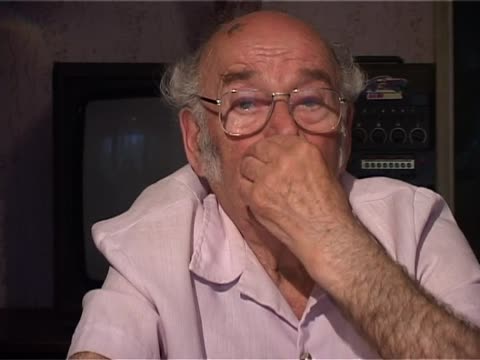
This tape is a continuation of a formal interview with Iosef (Yosl) Grigoryevich Grayf (b. 1922 in Kolomyya). He speaks generally about prewar Jewish life in Kolomyya, and mentions that there is another Jew in the town who knows the history better than he does, but not Yiddish. Noting that this person is Jewish only on his father’s side, Grayf shares his negative views of Jewish law vis-à-vis the question of matrilineal or patrilineal descent. He comments on shabes (Sabbath) observances from before the war, focusing on the foods they would eat, including gefilte fish.
Kerler asks about prewar Kolomyya and its synagogues. Grayf says it was almost a Jewish town, though Christians lived there too. He names a local man, Boyko, who knows more of the town's history but speaks no Yiddish. Grayf says Boyko has a Jewish father and a non-Jewish mother, and objects to the rule that recognizes descent only through the mother; Kerler explains the rabbis' practical reasoning. They discuss the old synagogue, called the Jerusalem synagogue. Grayf says his parents kept the Sabbath, and answers Kerler's question about the taste of gefilte fish (sweetish).
Also covers the old synagogue, the Jerusalem shul, and Kerler's mention of a professor from Kolomyya.
Grayf details other holiday observances and traditional foods, and speaks about Yiddish dialects and Kolomyya’s contemporary Jewish community. He briefly returns to the subject of general prewar Jewish life, noting the different Jewish professions and many Jewish artisans in the town.
Grayf answers Kerler's questions about Hanukkah: lighting candles, the shammes, fried potato pancakes and doughnuts. He also discusses Shavuot dairy food and fasting on Tisha b'Av, Yom Kippur and Fast of Gedaliah. Kerler uses the words for pancakes and for 'shop' versus 'kleyd' to discuss dialect differences, and Grayf says the local forms are Ukrainian-influenced Yiddish. Grayf says Kolomyya had many Jewish tradesmen and shopkeepers.
Includes a dialectological digression on word forms for pancakes and shop, and on Polish versus Ukrainian Yiddish.
Grayf discusses the non-Jews who spoke Yiddish in Kolomyya before the war, and speaks more broadly about anti-Semitism and Jewish-Christian relations in that period. He comments on contemporary economic conditions and the drastic changes in the town in the prewar, postwar and post-Soviet periods.
Grayf says some non-Jews in Kolomyya learned Yiddish from living among Jews. He says the Yiddish word for Jew carried no insult and that Jews were not robbed or murdered before the war. Kolomyya's shops were almost all Jewish, while Poles and Ukrainians held butchers' trades and a few other shops. He guesses about forty thousand Jews lived there, and mentions that there were no Jewish firemen. Kerler also asks about converts and mixed marriages, which Grayf does not remember.
Adds Kerler's questions about converts and mixed marriages, and the estimate of the town's Jewish population.
Kerler asks about Zionist and political youth groups, and Grayf recalls only some of them, among them the Bund. He remembers there was a Jewish football team. He read Yiddish books and newspapers before the war but remembers little, and does not remember a public library. Asked about Hasidim, he says there were rabbis.
Adds Yiddish reading, the football team, and Kerler's question about rabbis.
Kerler puts the dialectological questionnaire to Grayf, giving many items in Russian for him to say in Yiddish. They cover body parts, animals, colours, comparatives and adverbs, verbs and adjectives for illness, belief, fear and listening, and everyday words (house, attic, bed, vodka, the numbers, potato). Kerler also asks for forms for kinship (grandmother, grandfather), prepositions and the plural of 'enemy'. Kerler also asks Grayf to translate sample sentences.