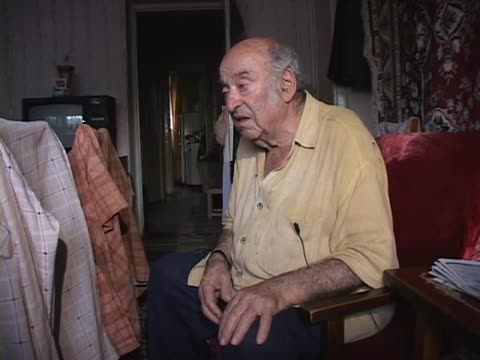
Iosef (Yosl) Grigoryevich Grayf (b. 1922 in Kolomyya). He speaks about prewar Jewish life in Kolomyya and his education in a supplemental twice weekly Hebrew school. He also talks about his parents and Jewish religious life in the town, describing its numerous synagogues. He also makes several comparisons with the much reduced Jewish life in Kolomyya today and how the contemporary synagogue often has trouble securing a "minyen” (minyan, prayer quorum of ten men).
Katz introduces the team and the date. Grayf gives his name and says he was born in Kolomyya, and names the street where he lived, near the town hall. He says he remembers little of childhood. He recalls a mostly Jewish town, with a Hebrew school twice a week separate from the state school. His father Gershon worked in the timber trade. He describes the many synagogues and a time when a minyan was easy to find, compared with today when ten men are hard to gather. He estimates the prewar population and the Jewish share of it.
Adds the father's name and trade, the estimated population figures, and Grayf's remark that he forgot Yiddish during army service.
Grayf speaks briefly about the presence of Hasidim in his prewar town and compares them with contemporary Hasidic pilgrims to Ukraine from Israel. Grayf describes prewar interethnic relations, commenting on the general lack of anti-Semitism, which only began to appear in 1939 when Germany invaded Poland.
Asked about Hasidim, Grayf says little. He says he remembers them looking like other Jews and doubts that those seen on television resemble them. He describes relations with non-Jews before the war: Poles and Ukrainians, more Poles, with little antisemitism. He says it began only around 1939, when the Germans started inciting. He adds that the border was close, so events in Germany reached Kolomyya fast.
The Hasidim are said to be absent today and seen only on television; the Polish and Ukrainian shares of the population are discussed.
Grayf talks about Jewish organizations and clubs in Kolomyya before the war, including HaPoel and the Bund. Grayf’s mother had seven kids. During his youth Grayf’s family lived in an apartment near the town hall.
Grayf struggles to name prewar Jewish organizations; he recalls a sports club, Hapoel, with a football team. He names his mother, Etl, and lists his siblings by age, among them Pinye, Munye, David, Shimshn and Hersh. He says seven children survived of nine. The family lived in a rented apartment near the town hall. He cannot recall a song.
Adds the names of the siblings and the football team; the Bund does not appear in the transcript.
Grayf discusses his war experiences, during which he was evacuated and then served in the Red Army. He also shares the fate of other members of his family who were either killed or survived and eventually immigrated to Israel. Commenting on Ukrainian-Jewish relations during the war, Grayf states that anti-Semitism was introduced by leaders such as Stepan Bandera and has since remained in the country.
Grayf says he worked on the railway when the war began and left for Russia within days, while his parents stayed. His parents were taken to the ghetto and deported; many Jews were shot nearby and others sent to Germany. His younger brother and sister jumped from a transport; the sister was caught, the brother hid in town and later reached Palestine and Tel Aviv. He says Ukrainians sheltered some Jews, and he blames Bandera's followers for antisemitism after the war.
Details the siblings' escape from the transport and hiding; the army service itself is not narrated here.
Grayf discusses his military service and return to Kolomyya after the war. Although he found no family left in the town and few friends, he decided to stay and describes the general atmosphere of the period as stable, secure and peaceful.
Grayf says he served in the army, was wounded and then worked in a town in Russia until the war ended. He returned to Kolomyya, where he had learned from official inquiries that no family remained. He knew few people, so he looked for work and stayed. He calls life after the war not bad: people worked and lived, and people get used to hardships.
Adds the wound and hospital stay and the inquiries that told him his family was gone.
Grayf shows the researchers his jacket bedecked with war medals and explains the significance of each one. He remarks on the respected social position of veterans in contemporary society. Grayf then discusses the state of the contemporary Jewish community of Kolomyya, detailing the humanitarian aid received through the "Joint” (the American Jewish Joint Distribution Committee) and the elderly welfare organization Hesed-Leib. Grayf details the pension he receives and provides an overview of the contemporary economic situation in Ukraine.
Grayf shows his medals and jacket and says which were for the war and for later anniversaries. He says veterans are treated well today and honored at holidays. He describes the help received in Kolomyya from the Joint, sponsors, and Hesed with daily meals. He gives his pension as about 580 hryvnia a month and compares it with earlier, much lower pensions.
Adds Grayf's remarks on how veterans are regarded and the comparison with earlier pension levels.
Grayf talks about the contemporary religious community in the city and how it has trouble securing a "minyen” on shabes (the Sabbath) in part due to the emigration of so many of its members. He then speaks about the lack of anti-Semitism in contemporary Ukraine and remarks generally about contemporary politics. Grayf states that he believes in G-d and shares his personal religious views of Judaism and Christianity as well as the religious revival in the country.
Grayf says his closest friends are those from the synagogue, but that it now struggles to gather even three to five people on Sabbath, whereas a minyan came every week years ago, before many left. He says there is little antisemitism now, and comments on the president and politics. He says he believes in one God for everyone, and speaks about Christians, the churches and monasteries being rebuilt, and symbols of the cross and the Star of David. He says he needs no help from America.
Adds his remarks on friends, politics and the president.
Kerler puts questions from the dialectological survey, including how to say come here, go there, twenty, thank you, vodka, Saturday, speaking with one's mother and father, the words for a thousand, husband, water glass and white. Grayf gives his Yiddish equivalents, sometimes hesitantly. Lighting and microphone are discussed briefly.
Grayf speaks briefly about the period of Soviet rule in 1939-1941 before the war began, noting that it was a happy time of increased economic opportunities. The Soviets did not close the synagogues in the town and religious life continued, according to Grayf, until the Germans came in 1941. Although Kolomyya’s synagogues remained closed in the postwar period, Grayf states that Jews came together in private homes to pray and celebrate shabes and the holidays through these years.
Grayf recalls the arrival of the Soviets in 1939, when people were glad and expected better times. Tanks passed and the Poles left. He describes it as a quiet time with work and no persecution. Religious life and schools continued until the Germans came. After the war the synagogues were closed, so Jews prayed in private houses on Sabbath and holidays, including Passover. He gives his birth date, family name and address, and his telephone number.
Adds the postwar Passover observance, Grayf's birth date and the contact details.