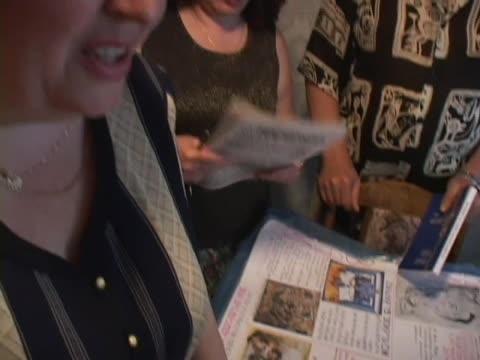
The first part of the tape is a continuation of a tour at the Korsun Museum of Regional Association of Jewish Shtetls in Ukraine. The team looks at a number of books and documents. The tour guides explain contemporary Jewish life of the region.
Continuation of the museum visit. The guides show books, newspapers and a songbook from a festival at which songs were sung in Yiddish, and mention a play about Janusz Korczak. They describe the activities of the regional association of Jewish shtetls: outreach to small towns and villages, finding people of Jewish descent, Holocaust lessons in schools, Jewish participation in the Red Army, a regional Sunday school, a family camp, festivals, community programs and charity. They add that the Jewish population is aging and shrinking, with some emigrating to Germany, and that the programs depend on volunteers and have funding problems.
The guides also speak at length about the association's programs, volunteers, Jewish soldiers in the Red Army and emigration, beyond the books and documents.
The second part of the tape is a formal interview with Mikhail (Meyshe) Zakharovich Ocheretianyi, born 1929 in Korsun. The team greets Ocheretianyi and sets up the interview with him and the camera collects of his house.
Ocheretianyi provides personal information and talks about his family. His father and grandfather worked as blacksmith. His father was born in Korsun. Ocheretianyi grew up with two brothers. His brother Chaim served in the Red Army and fought at the front during World War II. His uncle was the director of a kolkhoz in Ukraine. His brother Shloyme moved to Israel.
Ocheretianyi gives his surname and his Yiddish name, Moyshe, and talks about his family. His father Zelik and his grandfather were blacksmiths (the exact Yiddish word is unclear), and his mother Sosye was a housewife. His father was born in Korsun in the 1890s (?), and the Yiddish and Russian names of his father and grandfather are discussed. He had two brothers; one served at the front and later worked on a kolkhoz as chairman, and the other, Shloyme, lives in Haifa and wants him to visit. He then describes his own work as a cutter of shoe leather and later a brigadier and factory director, his army service in the 1940s, and his schooling in a Ukrainian school after the Yiddish school was closed.
Beyond the family, the passage covers his own trade as a shoemaker, his army service, his schooling after the Yiddish school closed, and the names of his relatives.
Ocheretianyi talks about life during the war and describes how his family evacuated with four horses and a wagon to Voronezh, Russia. They continued to evacuate to Kazakhstan by train. In Kazakhstan, his brother and father were drafted into the Red Army. They stayed in Kazakhstan in 1944 and then returned to Korsun. Ocheretianyi then talks about life in the immediate postwar period. He explains how his father worked and built their home.
Ocheretianyi describes the family's evacuation when the Germans approached: they travelled by horse and wagon as far as Voronezh and then by train to Kazakhstan. In Kazakhstan his father and brothers were taken into the army. They returned to Korsun in 1944, and his father built a forge and worked there. Later he himself was drafted.
Ocheretianyi discusses his childhood memories and Jewish life in prewar Korsun. According to him, the synagogue was closed down before the war. Ocheretianyi refers to postwar prayer services in private homes. He then talks about his observant father.
Asked about his childhood, Ocheretianyi recalls that the synagogue was closed before the war, and that after the war prayer was held in a house bought for the purpose. He describes his father, who was observant: he did not work on the Sabbath, wore a tallit and prayed, kept the holidays and had prayer books, which he later passed on to a friend. Ocheretianyi cannot read Yiddish, though his brothers could.
Ocheretianyi talks about holiday celebrations, including Sabbath and food customs. He specifically recalls Passover and Purim celebrations, as well as traditional weddings with a badkhen (wedding jester).
Ocheretianyi recalls prewar holidays in his parents' home: his mother's Sabbath cooking, his father fasting on Yom Kippur and Rosh Hashanah, and Passover matzo baking with the house kept free of chametz. He recalls Purim, with singing in the Jewish streets, mutual gifts and filled pastries, and a Jewish musician who played at weddings and made wedding speeches in rhyme. He also remembers Hanukkah, when children went round for money, and the dishes made (fried fish, gefilte fish).
The passage also covers the Purim customs, the musician at weddings and Hanukkah money, as well as the holiday foods.
Ocheretianyi compares prewar and contemporary Jewish life. According to him, Korsun had a Jewish population of 2,500. He then continues to recall Hanukkah and Passover celebrations. Ocheretianyi also remembers non-Jews speaking Yiddish, in particular a wagon driver called Ivan Nahayets. Ocheretianyi explains how Nahayets was mistaken for a Jew at first during German occupation.
Ocheretianyi compares prewar and present Jewish life: before the war Korsun had about 2,500 Jews, and now very few remain. He returns to Hanukkah foods and Passover at home, then recalls non-Jews who spoke Yiddish, especially a wagon driver, Ivan Nahayets (?), who learned it living among Jews. Under the German occupation he was suspected of being a Jew and was checked physically before being released. Ocheretianyi also notes that he worked among Jews in a shoemakers' shop where many non-Jews spoke Yiddish.
Gives the non-Jewish Yiddish speaker's name and his near-arrest under the Germans, and compares the prewar and present Jewish population.
Ocheretianyi talks about Shavuot, when dairy-based baked foods and dumplings were eaten, and about Yom Kippur. His parents fasted, and after the war his father prayed with a friend at home. Kerler asks about the pre-fast meal and about food terms.
Ocheretianyi answers a series of dialectological questions from the AHEYM Yiddish linguistic questionnaire. He then talks about life today and his family in Israel, as well as Jewish life in prewar Korsun.
Kerler and Katz ask a few dialect items (the words for a dybbuk, ears, quick, pious, paradise and the afterlife). Ocheretianyi then talks about life today, which he says is neither better nor worse, and about his brother in Haifa, who phones him and invites him to visit, though the trip is expensive. Katz asks for lively memories of the shtetl, and Ocheretianyi starts to speak about the town madman and his family.
The questionnaire items come first, then the brother in Haifa and the town madman.
Ocheretianyi talks about his uncle, a strong man who worked on a kolkhoz and at a factory before the war. Under the Germans he was killed, and the sons of the family were taken away as teenagers. The passage trails off.