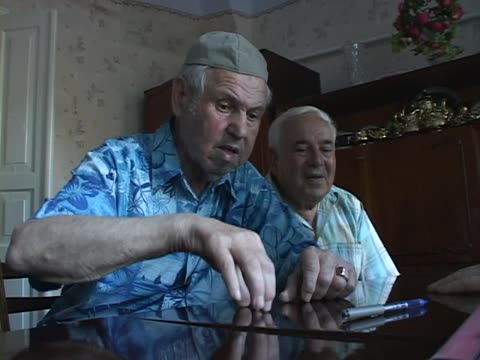
The first part of the tape is a continuation of a formal interview with Mikhail Zakharovich Ocheretianyi. Ocheretianyi talks about prewar Jewish life and addresses the synagogues. He then describes childhood games and talks about the observance of his father, who was imprisoned before the Revolution.
Ocheretianyi answers questions about a kolkhoz office, drinking and the Yiddish word for vodka, then about the prewar synagogues, of which there were two, and a women's one. He describes childhood games with nuts and hide-and-seek, and his honest father, who collected money for the poor. He recalls how a house was bought for a prayer house after the war and how his father, a soldier, lost part of an ear and was imprisoned. A teacher named Yankl Meir taught Jewish boys, and Ocheretianyi says he cannot recall prayers. The passage closes with a Yiddish word elicitation and Kerler's remarks about an old house.
Also covers a dialect word question and the teacher Yankl Meir
The second part of the tape is a formal interview with Samuil (Shmiel) Borisovich Belobrov, born 1929 in Korsun. Belobrov provides personal information and talks about his family. He also briefly addresses the history of his house, built in 1897. Belobrov’s father, a tailor, was born in Boryslav and his mother in Shpola.
Belobrov gives his name and background. He was born in Korsun and called Shmuelik at home. His father was Ber and his mother Reyzl. His parents bought half of a house in the 1930s, a house built in 1897. He says more than half of the prewar town was Jewish. His father came from a town rendered Baslav (probably Boryslav) and his mother from Shpola. He also names his grandparents.
Adds the parents' and grandparents' names, and the town's Jewish majority
Belobrov discusses his childhood memories. He attended a Ukrainian school for five years. He then talks about his family. He grew up with two brothers. His brother Peisye, born in 1938, died in evacuation in the Kazakhstan. Belobrov’s other brother Meylekh, born 1931, lives in Vladikavkaz, Russia. Belobrov’s grandparents and uncle were killed during the war.
Belobrov says he went to a Ukrainian school and finished five classes before the war. He did not attend a Jewish school, and his father was a tailor. He had two brothers. The younger one died in evacuation in Kazakhstan, and his brother Meylekh, two years younger, lives in Vladikavkaz, where Belobrov keeps contact with him. His maternal grandparents and an uncle were killed by the Germans in Shpola. He worked for decades as a lathe operator at a factory.
Belobrov talks about his life after the war. He worked as a turner at a lathe in a factory for 44 years. Belobrov then talks about his life during the war. His family evacuated three times within Russia: near Rostov, near Stalingrad, and Kemerovo. In Kemerovo, Belobrov worked in a factory for military goods at 14 until 1945.
Belobrov describes the wartime evacuations, three in all: near Rostov, then near Stalingrad, then to Kemerovo. At fourteen he worked in a factory casting aerial bombs there until 1945. The family was kept mobilized afterwards. His father was drafted into the army in 1941.
Belobrov talks about his life and work after the war. His father was drafted into the Red Army in 1941 and returned to Korsun before his family arrived from Kemerovo.
Belobrov tells how his father returned from the army first and sent for the family, so that he and his mother later returned to Korsun. He describes his father's work at the factory, where he was a respected, honest worker. The factory dated from before the Revolution, and many Jews worked there. Kerler then asks him to turn to his childhood.
Adds the factory's prewar origins and its Jewish workers
Belobrov discusses his childhood memories and holiday celebrations. He maintains that his parents did not work on holidays, although they did not attend services at the synagogue. His father, a handicraftsman, often worked from home, where he could observe Sabbath. Belobrov then recalls Passover celebrations with neighboring families and shares a recipe for gefilte fish.
Belobrov recalls childhood play in the street and says his parents were not strongly religious. They still marked Passover, Hanukkah and Yom Kippur, though they did not go to synagogue. His father, a tailor, worked at home and so was able to keep Sabbath. Friday evening was a festive meal. He describes baking matzo together with neighboring families, and gives a detailed recipe for gefilte fish. He also mentions Jewish song and a choir that travelled to Kyiv, and non-Jews who spoke Yiddish.
Adds the matzo baking with neighbors, the choir trip to Kyiv, and Yiddish-speaking non-Jews
Belobrov answers a series of dialectological questions from the AHEYM Yiddish linguistic questionnaire and addresses food customs. An unnamed woman talks in Russian about her family. Belobrov also compares a “dorf” (village) and a “shtetl” (market town).
Belobrov takes part in a dialectological questionnaire, translating Russian words and sentences into Yiddish. The items include the word for vodka, thanks, mouse, groats, skin, pleasure, dove, deaf, sun, son, kiss, hand, late, cold, close, faster, breath, stingy, sick, honest, believer, cross, peasant. He also describes a meat dish called rasl (?) and its seasoning. A woman speaks in Russian about a relative who was a party secretary. At the end he discusses the difference between a village and a shtetl, and says Jews also lived in villages before the war.
Adds a Russian-language account by a woman, and the shtetl/village distinction