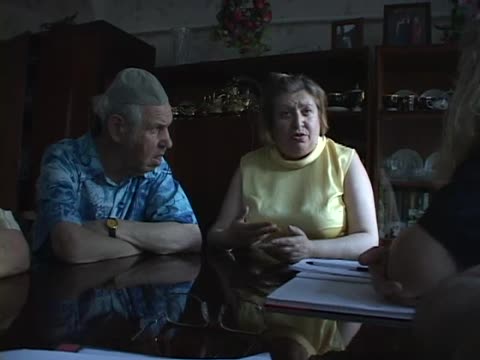
Belobrov compares a “shtot” (town) and a “shtetl” (market town). He then answers a series of dialectological questions from the AHEYM Yiddish linguistic questionnaire.
Kerler and Katz discuss with Belobrov and a second informant whether places such as Smila, Uman and Berdychiv count as a town or a shtetl, apparently by whether they are subordinate to the region; Uman is a big town with a park and a tsadik. The rest is dialectological questionnaire work in Yiddish and Russian. Items asked include flowers, the numbers twenty and the teens, grandmother and midwife, 'tasty', 'to dig', 'well', 'potato', the prepositions 'at the table' and 'on the street', and sentences to translate. There are also a few asides on the dead, the border with Poland and a person's home language.
Adds that the passage is mostly extended questionnaire work with terms for objects, numbers and sentences, plus some talk on the Polish border and the dead.
Kerler and Katz ask the informants for a story or a song from before the war, and one of them is invited to sing a little song. Kerler thanks the two informants for a double interview in one sitting. The tape then ends with a few remarks about garden plants such as dill and parsley, apparently with town footage.