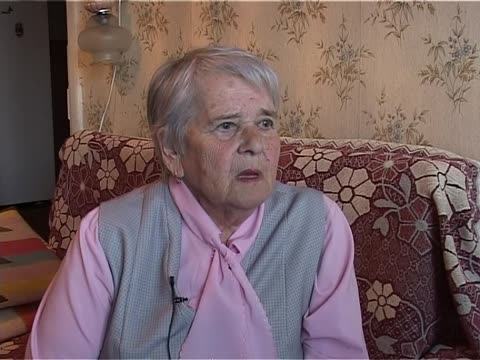
Long dialectological questionnaire session with a woman, led by Kerler, who gives Russian prompts and asks her to translate them. Items include words for house, room, table, bird and dove, body parts, adverbs of time and degree, and comparatives. Also covered are verb forms and prepositions, the numbers, 'right/correct', the words for 'many', 'other' and 'suddenly', and Hebrew-derived words. Kerler notes which forms are Polish, Belarusian or Lithuanian-Yiddish in character.
Short closing of the questionnaire session, with Kerler thanking the woman and some talk about the linguist Dovid Katz and Lithuanian versus Polish Yiddish. A Russian remark about someone's brother coming from America and being in Warsaw is also heard.
Setting up the interview with Gershtein. He speaks of his brother in America, who was denied a visa for a visit, and of the search for Yiddish speakers in the region. Gershtein then shows his native village Holoby on the map. He says that thousands of Jews are buried in the woods near it, that he asked authorities in Luts'k for a memorial, and that many Jews lived there. Kerler begins filling in the personal-data form.
Gershtein gives personal and family details. His Yiddish name is Avrom, and he was eighteen during the war years. His father Motke(?) was born in Holoby in the 1870s (?) and worked at a slaughterhouse. His mother Gitl sewed at home on a machine together with another woman. There were six children. Gershtein names several siblings, among them Shmuel, Khave and Yankl, and says some family members went to America and Israel after the war while he was in the army. His grandfather Moyshe Itskhok died in America (Detroit?). Gershtein also recalls his uncle, aunt and three children killed in the woods, and says the town was called Kovel in Yiddish.
Gershtein describes his childhood in Holoby. He completed seven grades of the school and for two or three years attended cheder in the synagogue under the old teacher Berl Shuster. The teacher beat pupils, girls included, with a whip for not studying. Shuster's son Bentsiye later taught Yiddish, and Gershtein mentions Poland's rule at the time.
Gershtein tells how, in June 1941 (?), when the war began, he fled with two friends and a girl, Roze Prager, who later died in America. They left their parents and travelled at night by horse-drawn carts. He was thirteen at the time. On the road they saw German aircraft, and he describes the group's flight.