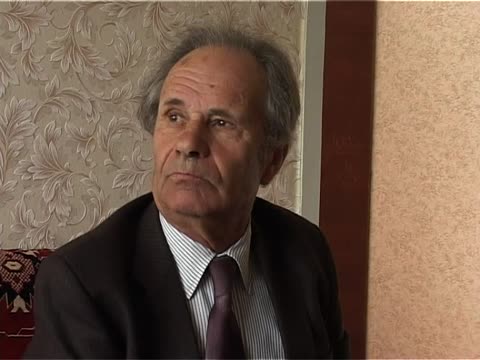
Gershtein recounts his flight at the start of the war as one of four children. They reach Sarny, meet the Red Army in the woods, and a commander named Kuznetsov (?) arranges for them to reach the evacuation trains. A bombed bridge stops the train; they spend the night in a field, barefoot and with little clothing. A freight train takes them to Kyiv, where they are fed and put to work digging potatoes. He is then sent to Andizhan.
Details of the bombed bridge and the freight train to Kyiv.
Gershtein says he was drafted into the army in 1944 and served first as an infantryman and later as a sapper. He remained in service until 1949 and now lives as an invalid with a leg disability.
Gershtein describes his return to Holoby after the war to look for his parents. His house had been taken over and damaged, and lawyers told him he had no case. He then studied at a commercial cooperative technical school and worked for years.
Gershtein talks about his postwar work, including as a director of an office, and his move to Kovel' in 1968. He says no Jews returned to Holoby and someone told him his parents had been shot. In 1970 he learned that his parents and siblings were in America. He holds a diploma in commodity studies.
Move to Kovel' in 1968 and the discovery of his family in America.
Gershtein names his siblings who ended up in America, including a brother who served in the Polish army and was wounded in Warsaw. His mother survived, but his father's fate is unclear in the transcript. He tells how his mother's sister Chaye Sore and her husband Rakhmil (the uncle) and their three children were killed; the uncle chose to go to the shooting with his family rather than save himself.
Names and fate of his uncle Rakhmil and his aunt's family.
Asked about the town before the war, Gershtein says many Jews lived in Holoby alongside Poles and Ukrainians. Until about 1936 people lived in peace and he did not know antisemitism. He mentions a non-Jewish man living nearby who speaks Yiddish and works as a journalist.
Mention of the Yiddish-speaking non-Jewish friend.
Kerler and Gershtein discuss contacting the non-Jewish Yiddish-speaking friend by telephone, and Gershtein phones him in Russian and Ukrainian to ask him to come. Kerler then asks about the words for corn and wheat.
The phone call to the friend and the exchange on corn and wheat.
Gershtein describes Holoby's big synagogue and the ritual bath he visited with his father each Friday, and names two ritual slaughterers, Chaim Wolf Goldberg and Abba Sima. He says the nearby villages had only small prayer houses, and that the dead of Holoby were taken to Mel'nytsia for burial. He mentions a rebbe in Lutsk, childhood games, bathing in the river and a Polish ball game. His siblings were pioneers (khalutsim). He also recalls the Zionist youth club, where children danced and sang Yiddish songs.
Gershtein sings or recites a Polish song and a Purim song in Yiddish and explains that the children went from house to house as Purim performers to earn money.
Gershtein recalls going from house to house in the Purim play in 1936–37, aged about ten, and earning a lot of money from the wealthy. He names the miller Matl and the miller David Katz, who each gave a coin, and describes the poor and the wealthy in town. His uncle Rakhmil Vitsnudl kept a dairy, and he remembers the wandering poor, a Sabbath meal for the poor, the Slikhes wake-up call and the slaughterers' homes.
Wealthy and poor families, the dairy and the paupers at the Sabbath.
Kerler asks about clubs, social life and a Friday evening event, and Gershtein recalls going with his father to the synagogue for a Sabbath evening meal and prayers. He says he can read Hebrew prayers from the siddur, and Kerler asks him to read the Modeh ani and the Kiddush blessing.
Gershtein reads or sings aloud prayer texts at Kerler's request, and Kerler comments on the Hebrew and Yiddish pronunciation. He then mentions the rabbi in Lutsk.
Gershtein talks about medical care and the cost of living today, noting that as an invalid he pays nothing for the doctor. He says no Jews prayed in Holoby after the war and that it was forbidden. Kerler asks about the synagogue in Kovel' in the 1960s, and the interview is declared to be ending.
Gershtein's non-Jewish friend arrives and is introduced to Kerler, and they talk in Yiddish and Russian. He is a correspondent for the Kovel' city paper, and he says he speaks Yiddish only a little. He speaks about a journalist for a news agency who came looking for a relative.
The friend's arrival and his work as a journalist.
Kerler asks the friend about his home village of Rozhyshche, and he gives his name as Ignat Petrovich, surname spelled Olchowicz (?). He speaks about the town's Jewish population before the war, saying it was large and many were shot, and the Yiddish name of the town is discussed. Kerler asks how many synagogues there were, and the answer is one. The friend mentions a family named Pen and explains to the team that they are researchers recording interviews.
The friend's name, the village and the family of Pen.
Gershtein tells a childhood anecdote, apparently about a Lithuanian Jew who said "sukke" instead of "sekke". Kerler asks what kind of Yiddish was spoken, and Gershtein compares the words for succah, bread and merchant as said by Jews and non-Jewish neighbours.
Gershtein and the friend sing parts of Yiddish songs, including one about the street and the girl, and Gershtein sings Polish songs. They talk about Eddie Rosner and the popular Russian version of a song. Kerler asks about Hasidic melodies.
Asked about holidays, Gershtein recalls Shavuot as the day the Torah was given and the foods eaten, including blintzes with cheese or meat and dairy dishes. He mentions the custom of putting greenery in the house and asks about Passover songs, including Khad gadya. He recites the four questions and says he asked the Passover questions as a child. A book on the Jews of Kovel' is also mentioned in Yiddish.