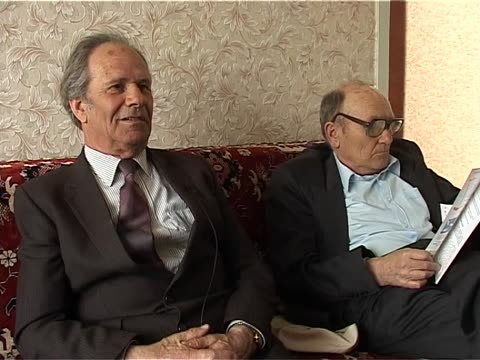
Kerler asks about Hanukkah: the candles, Hanukkah money and the foods eaten on Hanukkah, especially potato latkes, as well as other holiday foods. He also asks about food before Yom Kippur. The informant answers briefly and often cannot remember.
Yom Kippur pre-fast customs and the eating of kreplach are also covered.
Kerler asks whether non-Jews converted to Judaism before the war, and the informant says there were such cases. They also discuss Jews who converted away from Judaism. Kerler then asks for the Four Questions of the Seder to be read, and they talk about Yiddish and Hebrew wording of some of the phrases.
Includes the Four Questions being read and a few Yiddish wording details.
Informal talk about where the team has travelled and where they come from (Kyiv, Polonne and Izyaslav, Slavuta, Rivne, Lutsk and Kremenets), partly in Russian and Polish. Kerler tells a joke about a Jew asking for water, and a Polish song is mentioned. At the end Kerler asks about a sports club in the town.
The informants recall prewar cultural life in the town: a mixed Jewish and Polish football team, political movements (Bund, communists, Betar and Hechalutz), and visits by a Yiddish actor and singer named Shuster-Meyr (?) who performed songs. They discuss Jewish periodicals, books read (Sholem Aleichem, Peretz), and a Yiddish film given to a museum in Kyiv. The informant tries to retell the film's plot, and Kerler asks about a library and the cinema, which the informant says showed no Yiddish films.
Covers sport, youth movements, press and books, as well as the film.
Kerler asks about the terms rov, rebbe, melamed, Hasidic rebbe and their plurals, then expressions such as 'a good place' for a cemetery, beys-oylem, a good Jew, a tsadik, Galitsianer and misnaged. They then compare Lithuanian and local Yiddish pronunciation (sibilants and the r). Some Russian talk about the history of Yiddish is mixed in.
Rabbinic terms and dialect comparison are covered.
Kerler asks about Jewish weddings before the war. The informant describes the chuppah, the rabbi, the blessings, the meal with wine and brandy, dancing and klezmer musicians. Kerler asks about wedding songs and the 'mitzvah dance'.
Talk about food customs: the taste of the mother's gefilte fish, how much salt and sugar it should have, and making it for holidays. Kerler asks about drinking brandy, wine, beer and kvass, and the father's birch-sap kvass. At the end he starts asking about folk remedies and charms.
The informant recalls an old woman who healed by 'exorcising' the evil eye by spitting and similar acts. Kerler asks for more terms: an obstinate person, a dybbuk, a golem and a fool.
Kerler puts questions from the dialectological questionnaire in Russian for translation into Yiddish: greetings, please and thank you, mouse, belly, creeping, window, colour words, a pious person, an honest person, a headache, 'twenty', 'where are you from', pronouns, 'to be', 'I speak with mothers' and the phrase 'at father's'. The informants answer, correct and discuss the forms.
Town footage and talk about the team's route (Lviv, Drohobych, Chernivtsi, Stanislav, Podolia), then talk in Russian and Yiddish about a nearby former Jewish shtetl whose name is unclear in the transcript, with a tsadik's grave. Oykhovitch points out a building that once had Stars of David on its rings and balconies. The tape ends with the Victory Day memorial service, with Russian and Ukrainian speeches, a discussion of five honoured soldiers (one with a Jewish father), and the parade.