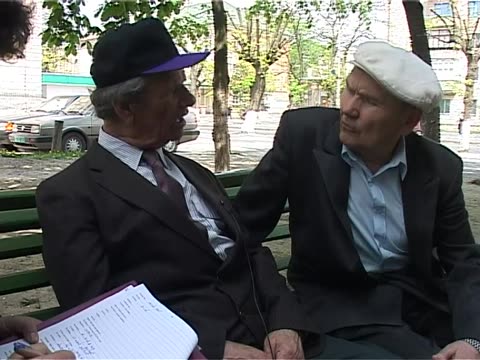
Dialectological questionnaire: Kerler goes through everyday Yiddish words with Oykhovitch and others, checking Slavic-influenced forms against Yiddish ones. Items include flower words and the difference between two of them, 'cooking oil', 'well', 'potato', numerals, 'must/need', 'to arrange', 'to dig', 'to pray', 'grandmother/grandchild', 'beard', 'full of people' and 'return'. Songs and a few sentences to translate come up, and Oykhovitch mentions his Polish school and Polish relatives at the start.
Informal chat with Kerler about a Hebrew song from Betar days and about Yiddish dictionaries, universities and academic degrees. Kerler talks about his own position as a professor. The talk moves to cheder and Tarbut schools, the melamed in Sholem Aleichem, and the Rothschilds. It ends with a toast of vodka, tea and a remark about someone who stayed home on Victory Day.
Kerler recites or recalls a few Yiddish sayings and rhymes, including one about wine and brandy making a man drunk. He asks the men for a song and then for a word. He jokes about age, saying he is forty-five and has lost interest in young women.
Informal chat as the recording winds down. Kerler asks for the men's addresses and tells them that the material will be archived and compared across places. He says that Professor Veidlinger is collecting material on history and memory. There is a remark about the Jewish origin of the surname Oykhovitch.
Town footage with Russian and Ukrainian talk among those present, partly about the former synagogue as a historical monument, its director and planned repairs of facades. They also discuss finds of buried gold coins and the state's share of them. Yiddish remarks by Kerler and Oykhovitch are scattered through the talk.
Restaurant and synagogue footage. There is Russian talk about a call from Zhytomyr and an upcoming Jewish festival in Vinnytsia, and a long garbled stretch that may involve a prayer or text. Kerler explains to a passer-by in Russian that the team is on its way to Lviv and is looking for old Yiddish speakers. The man remembers neither Yiddish nor Hebrew. They also discuss an old printing house, and the end is only scraps of Russian about addresses.