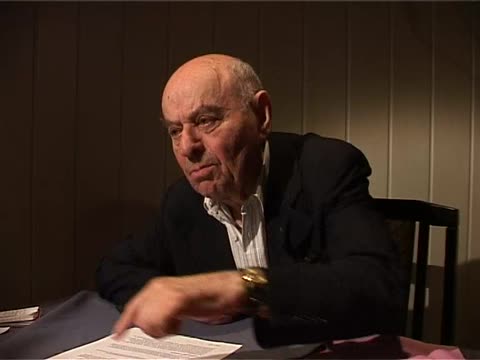
Pensatii speaks in Russian about two years working underground in occupied Kyiv under a false Muslim (Kumyk) identity. He tells how he was denounced and brought to the German commandant's office, where a German officer vouched in writing for his false papers and he was released. He also mentions Raisa Akipnaya of the Kyiv underground and says he saved many people. Kerler thanks him at the end.
Gives the story of the false papers and denunciation in the commandant's office, and Raisa Akipnaya of the Kyiv underground.
Dorfman discusses his large library and the lack of anyone to give it to; he has two grandchildren, one a student. Kerler suggests a university or academy library, and Dorfman mentions a professor there who writes on Jewish history and the Holocaust, one of whose books was translated into German. Kerler then turns to Dorfman and recalls meeting him earlier in Oxford (?).
The professor and the books are discussed through Kerler's suggestion of a library; Kerler introduces Dorfman.
The interview with Dorfman begins: he mentions a visit to London and a small town named Cahul, whose Yiddish name he gives (unclear in the transcript). He describes its mixed population of Greeks, Turks, French, Germans and Gagauz, and says it was long under Turkey before passing to Russia. He gives his father's name as Mendel and explains his patronymic.
Dorfman provides personal information and speaks about his family. He lived in Chişinău until World War II. Dorfman explains that his parents were imprisoned in 1940 under Soviet occupation. His mother was released in 1947 and imprisoned again in 1949 until 1957. She then lived in Lviv from 1953 through 1963. Dorfman's father was a laborer.
Dorfman gives personal information: his Yiddish name, birth in 1923 on Shavuot, and life in Chişinău before the war. His parents, Malka and Mendel Dorfman, were well-known; both were jailed in 1940 under the Soviets, his mother serving long terms and returning later. His father was a skilled workman, and he recalls antisemitism.
Dorfman talks about his education at a religious school (cheder), kindergarten and Tarbut school, which he attended four years. Dorfman states that he grew up in a Zionist home and his mother was a well-respected figure within the local Zionist environment. Dorfman was a member of Gordonia. He then speaks about the Soviet occupation in 1940.
Dorfman recalls briefly attending cheder, then kindergarten and four years of Tarbut school, where Hebrew was taught in the Ashkenazic pronunciation. He says the family was strongly Zionist and his mother a respected Zionist leader. He was a member of Gordonia and intended to become a halutz. He then describes the Soviet arrival and confiscations, and the bad fate of his mother's large family.
Dorfman speaks about his family: his sister Pesia, who stayed with the grandfather and was killed in the ghetto, and the twelve siblings of his mother, whose names he works through with Kerler's help. He names his maternal grandmother as the daughter of a Chişinău rabbi and the paternal grandfather Barukh, and mentions a family branch from Galicia and an inheritance search from America.
Gives the names of his mother's siblings and grandparents and the search by an American relative.
Dorfman addresses his primary schooling at a Tarbut school. He then speaks about his parent's observance and recalls soldiers joining his family on holidays.
Dorfman confirms his four years at the Tarbut school, taught in Yiddish and Hebrew, and its director Slobodsky. He dates the Soviet arrival to 28 June 1940 and his parents' imprisonment in July for eleven months. He describes his parents' religious observance, including seders, with soldiers as guests, and starts to recite the Four Questions at Kerler's request.
Dorfman recites the Four Questions in Yiddish as he asked them at the family seder, and renders the Ha Lachma Anya passage. Kerler asks about Passover songs, and Dorfman starts to recall Chad Gadya and Adir Hu.
Dorfman sings fragments of Passover songs, including Echad Mi Yodea and Adir Hu, and Kerler asks about the tune and pronunciation of Chad Gadya. He then speaks about Yiddish songs and about visiting Yiddish theater troupes that his parents, prominent in the community, hosted.
Includes talk of visiting theater troupes at the end.
Dorfman talks about itinerant Yiddish theater, then the Yiddish writers he lectures on today, including the Chernivtsi poets (Stern?, Altman, Manger and Celan). He mentions Fritz Markish and Uri Zvi Greenberg and their museum, and publishing books in Kyiv. He speaks of reading the Yiddish paper 'Unzer Tsayt' before the war and meeting its editors.
Adds lectures on Yiddish and Chernivtsi writers, and Celan, Markish and Greenberg.
Dorfman speaks about prewar cultural life, including the Yiddish press and theater performances. He points out that his parents often invited journalists. Dorfman also mentions Sidi Tal, Sevilla Pastor and other artists. He then recalls the beginnings of the Soviet period when many artists arrived in Chişinău in the hope of a more liberal cultural atmosphere, Dorfman explains. He also attended plays by the Vilna Troupe and mentions other theater spaces.
Dorfman describes Yiddish theater in prewar Chişinău, including the troupes led by Sevilla Pastor and Dzhina Zlatoia, and the neighborhood of Ridel (?). With the arrival of the Soviets many actors fled from Romania and a state Yiddish theater was set up, with a new premiere each week. He also recalls the Vilna Troupe touring the towns and plays such as The Dybbuk.
Names Dzhina Zlatoia and the weekly premieres of the Soviet state Yiddish theater.
Dorfman talks about his education. He studied at a Romanian secondary school. He then speaks about the journal Soviet Heymland and his involvement in distributing the journal.
Dorfman says he studied at a Romanian gymnasium and learned his Yiddish largely from home and from Sovetish Heymland, which he distributed in L'viv. He tells of meeting the magazine's secretary Shuster and the editor Lizen (?), who urged subscribers to bring in new readers. Some people suspected him of being a spy for the KGB or Zionists. He also mentions a book by Lizen translated into German and his trips to Hamburg.
Adds his role as a distributor of Sovetish Heymland and the German translation of a colleague's book.
Dorfman discusses the theater at a place called Ridel (?) in Chişinău and the town's Jewish working-class population: porters, craftsmen and butchers. He lists Zionist and sports organizations such as Betar, Maccabi and Hashomer Hatzair. He recalls the Gordonia study circle reading Marx, with a Siguranța informer present, and debates and literary evenings.
Dorfman mentions Hebrew and Yiddish school plays, as well as teachers at the Tarbut school in Chişinău. He also speaks about regional Yiddish cultural life before the war.
Dorfman recalls acting in Hebrew school plays and describes the Tarbut school, a private school with teachers who composed melodies and a Romanian teacher with annual inspections. He mentions the daily paper 'Unzer Tsayt' and a relative at the Hebrew school in Tarutino. Asked about non-Jews speaking Yiddish, he says no, and contrasts Chişinău with more developed Jewish culture elsewhere, giving the contact details of a woman.
Dorfman recalls Hasidim in white garments visiting his grandmother's house in Chişinău, from Stefănești and Sadagura among others, and the rebbe's fundraising. He then talks about Lviv acquaintances, including the Shenker family, Rabbi Kapliovatsky and his father-in-law, Rabbi Silberfarb. He speaks of his many journalistic articles and of a Chişinău rabbi, Tsirelson, a member of parliament. Kerler ends the session, planning to continue.
Adds acquaintances in Lviv and the rabbis Kapliovatsky and Tsirelson.