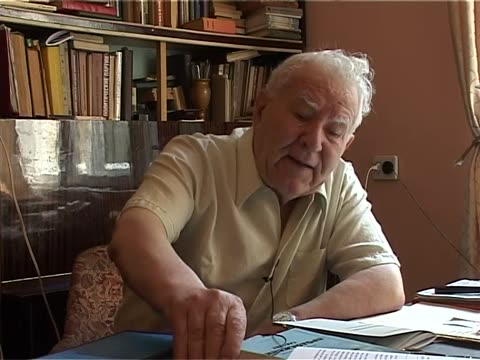
Khonigsman shows his published works, in particular a book translated into German by a German university team who worked with him in L'viv. He gives its price and says it also sells in America and Germany. He describes his work on Jewish topics since 1993, including a study of the Janowska camp. He also mentions a work on two vanished Jewish communities in the L'viv region and his photographs of the last Jew of one town. Much of this is in Russian.
Also covers the German translation, the Janowska camp study and Jewish towns in the L'viv region with no Jews left.
Khonigsman speaks about his encounters with Yiddish writers and Soviet Jewish historians. In particular, he remembers David Hofstein. The writers came to use the library Khonigsman worked at in the 1940s.
Khonigsman answers Kerler's questions about Soviet Yiddish writers and historians. He talks about David Hofstein, whom he met while working in the L'viv Yiddish library in the 1940s, and about the library's collection and its destruction. He names several scholars and critics who came to use it and discusses Soviet Jewish historians he knew or did not know. The passage ends with talk about Kerler's hotel and exchanging addresses, and his wish that something be published about Yiddish literature in Galicia.
Also covers the library's collection, Kerler's hotel and addresses, and Galician Yiddish literature.
Khonigsman speaks about contemporary life and his friend, the Soviet Yiddish writer, Alexander Lizen. Specifically, Khonigsman addresses Lizen's activism for the the State of Israel.
Khonigsman talks about his friend, the Soviet writer Alexander Lizen. Lizen was a bookkeeper in the army, learned Yiddish from a dictionary and mixed Russian into his speech. He had a Ukrainian wife, and in 1949 he urged Khonigsman to write a letter offering help to Israel, which Khonigsman declined. He then recalls a later Israeli publication and compares his own Yiddish with Lizen's. He ends with remarks on Lizen's character.
Also covers Lizen's Yiddish, his wife, and the Yiddish periodical.
Khonigsman answers Kerler's question about the difference between Polish and Soviet Jews. He says he never met a dishonest Polish Jew and gives examples of Polish-Jewish colleagues who refused bribes. He says he himself never took bribes or favours in his years at the institute and points to the Ukrainian nationalists' writings about him. Much is in Russian and Polish.
Khonigsman shows books from his library, including one by Sholem Aleichem and works by Hrynberg (?) and Markish. He talks about a Ukrainian Jewish writer who finished a Yiddish school and spoke fine Yiddish, whom nobody could bribe. Kerler asks his opinion of a book by Solzhenitsyn (?), which Khonigsman says is not a historian's work.
The interview with Meler begins. They talk about a Torah scroll. He then speaks about his family, who did not survive the war. Meler was drafted into the Polish Army in 1940.
The Meler interview starts, with Kerler talking with Meler about a Torah scroll and whether it is ritually fit, and about a local rabbi. Meler says that before the war his father, mother, three sisters and grandmother all perished and that he alone survived, having been taken into the army in the 1940s. He now has a new family and is going to see his daughter in Latvia. Russian side talk from others intrudes.
Also covers the discussion of Torah scrolls and Meler's family lost in the war.
Talk in the postwar Soviet period, about a museum of religion and atheism in L'viv with many Torah scrolls. Meler and Kerler then discuss shared acquaintances, including Tsilye and Grisha (the interviewer's own family connection) and Kerler's stay in Vorkuta as a child.
Meler provides personal information and talks about his life before the war. He was named after his mother's family, although he explains that at first his surname was Volf. His father's name was Samselik. Meler's family moved from Glina Navariya to Lviv in the early 1930s. He then describes prewar religious life in Glina Navariya. Meler has relatives in America.
Meler says he was born in Glina Navariya, near Donets (?), and that his family moved to Lviv, where his father got a share of the family's land sale. He describes the town as poor with a stone synagogue and cemetery, and a Belz rabbi's grandson. Kerler records the interview date and Meler's name, spelled Isaak, and Meler explains how the surname Volf became Meler, and that his father was Samselik. He also mentions relatives in America and his heart problems.
Also covers name changes, the town's synagogue and the Belz rabbi's grandson.
Meler provides personal information. He speaks about name changes at the beginning of the Soviet occupation in 1939. Meler then talks about his family and talks about the move from his hometown to Lviv for economic reasons. Meler grew up with three sisters. He mentions that he went into a merchant apprenticeship at the age of fifteen.
Meler gives his Yiddish name and describes how his name was changed to Isaak and his patronymic to Mozesovich in 1939 after the Soviet arrival. He names his parents, his mother Sarah, and his father Moyshe, and says he was born in 1919. He explains that the family moved to Lviv in the early 1930s, for economic reasons, after his grandmother sold land. At fifteen he was apprenticed to a merchant. He had three sisters and names two (Brani (?) and Khaye), whose trades were fashion and sewing.
Also covers the move to L'viv, siblings' names and trades, and the 1939 renaming.
Meler addresses prewar religious life in his hometown, particularly the synagogue and the local rebbe. According to him, approximately forty Jewish families lived in Glina Navariya. Meler then speaks about prewar occupational structure. His father and grandfather were kosher butchers.
Meler describes prewar religious life in Glina Navariya: a synagogue, a bes-medresh, a mikveh and the grandson of the Belz rebbe. Hasidim travelled to Belz. He says forty (or thirty-five) Jewish families lived in the town, with Ukrainians around the centre. His father and grandfather Rakhmiel were kosher butchers who bought calves in villages and sold the non-kosher hindquarters cheaply. Meler and Kerler discuss the term for the forequarter and hindquarter and removal of the sinew.
Also covers the term for the hindquarters and the removal of the sinew.