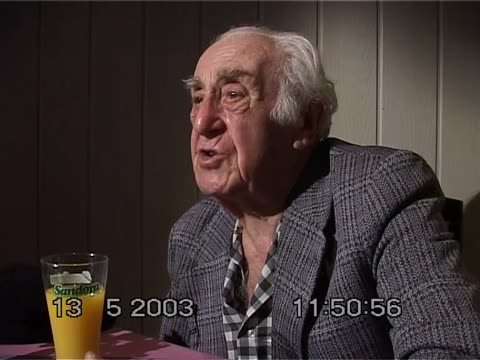
Meler speaks about his family and childhood memories, particularly education. Meler explains how his mother paid for his religious school education with food. Meler then describes his work as apprentice and remembers poverty within his family.
Meler answers questions about his father's livelihood and the town's shochet. He recalls his cheder teacher, who used a whip, the large class and the mother's payment in kind. He describes his apprenticeship in L'viv shops, his wages and the family's poverty and hunger.
The cheder teacher's whip and the apprenticeship in L'viv shops are added.
Meler speaks about Jewish life, including charity organizations. He also mentions the Lviv cemetery and describes how it was destroyed in the postwar Soviet period.
Meler talks about the prewar Jewish community in L'viv, its hospital and orphanage, and a holy site tied to a woman called the Golden Rose. He describes how Khrushchev had the old cemetery destroyed to make a market. He tells about an acquaintance who survived the war.
The Golden Rose and an acquaintance who survived the war are added.
Meler talks about his family. His father worked odd jobs, including with sausage dealer. Meler also speaks about prewar Jewish life, including occupational structure.
Answering Kerler, Meler explains that his grandmother held a few hectares of land and the father had no steady work. The father sometimes worked for a Jewish sausage maker. He also names Jewish firms in L'viv, including a chocolate factory.
Land measures and the L'viv chocolate firm are added.
Meler speaks about his hometown Glina Navariya and its geographic location. He recalls the bath house and mill. He also discusses his childhood memories.
Meler places his hometown as a railway station of that name about eleven kilometres from L'viv. He describes the bath house, the mikveh by the cemetery, a mill and the mill owner's heirs. He recalls catching carp in the pond as a child.
The mill, the mikveh and the carp fishing are added.
Meler speaks about his childhood memories, specifically how he caught fish for his mother's cooking for Sabbath. He also describes how his mother prepared dry fish for the winter season, as well as how she cooked cholent.
Meler recalls catching fish on Friday for his mother's cooking. He describes how she dried fish in straw for the winter, how the Sabbath bread was baked, and how cholent was prepared in the oven sealed with clay. The cholent included a calf's foot and beans, and the names for the dishes are discussed.
Meler continues talking about Sabbath food customs and mentions non-Jewish neighbors, who were his family's Sabbath goys. Meler then speaks about prewar Hasidic life in his hometown.
Meler talks about the Sabbath goy and the neighbours, who spoke some Yiddish, and about school fights. He describes cholent leftovers and cold dishes. He then recalls the Hasidic rebbe's table at the bet midrash, where herring and gefilte fish were served, and visits to the rebbe of Belz.
The rebbe's herring and gefilte fish at the bet midrash and the visits to Belz are added.
Meler describes Sabbath at home in his parents' house, with handwashing and blessings, and says he cannot recall the blessings he was taught. He then discusses Purim, when the Jewish households of the town exchanged gifts of food.
Meler speaks about prewar cultural life, including Zionist organizations that organized plays. Meler lists youth organizations, including HaNoar HaTzioni, Hashomer Hatzair and the Bund. Meler's step-brother made aliyah with a group of local halutzim. Meler then talks about local libraries.
Meler talks about prewar cultural life, including plays by Zionist groups and the Bund. He lists youth movements and says his step-brother went to Palestine with pioneers after farm training. He also answers questions about the town's libraries.
Meler addresses Shavuot celebrations, including food customs. He then shares an episode about a local resident, before talking about Jewish life today.
Meler answers questions about Shavuot, when dairy foods such as cheese pastries were eaten, and about Hanukkah latkes. He then tells of an antiquarian who found a parchment in the L'viv archive recording a killing of Jews by Khmelnytsky. He talks about a kosher kitchen next to a synagogue today.
The archive document about Khmelnytsky and the kosher kitchen are added.
Meler answers questions about the meanings of a dybbuk and a golem, and the plural of a fool. He then addresses prewar Jewish weddings in the town, with drink and musicians: he does not recall klezmers, who might have come from L'viv.
Kerler starts the dialectological questionnaire, asking how Meler would say words such as table, belly and house in his parents' Yiddish. Some of the exchange concerns Russian.
Meler talks about life today, including a problem with travelling to visit, and about visa and border trouble. A daughter, said to have a non-Jewish husband, is mentioned, and he speaks of a son-in-law, money in the bank and the difficulty of the bus journey. He regrets that there is little time left.
The visa and travel difficulties and the daughter's husband are added.
Kerler continues the word-list questions, asking for the Yiddish words for mouse and groats. The two discuss the difference between large and small mouse-like animals.