Dorfman talks, partly with the interviewer, about a woman scholar with theater connections and the work of the local community. They make arrangements to meet someone by mobile phone and ask about a toilet. The passage is mostly practical talk at the synagogue; the transcript does not show an explanation of exhibits clearly.
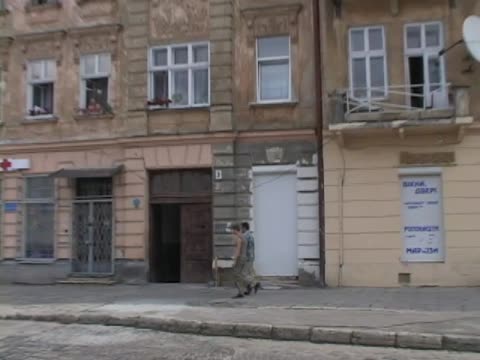
The group walks through the former Jewish quarter, stopping at a building numbered three with an old Polish inscription for a barber. Dorfman explains that this area was the big market where Jews made their living in small shops, and that Jews settled outside the ghetto after the Austrian reforms of the 1860s. He also shows English and Russian books about Jewish L'viv, which Kerler wants to buy, with a price mentioned in dollars.
The team and Dorfman drive around Lviv, while Dorfman points out former Jewish buildings, including the Yiddish theater, the building, where Sholem Aleichem lived and the old cemetery.
Driving and walking through L'viv, Dorfman points out former Jewish sites: a Yiddish theater, the street named for Meir Balaban, where Sholem Aleichem lived (marked by a monument), the two synagogues on a former Jewish street, the old cemetery and Jewish hospital. He also names the Jewish community building, the Bnai Brith house, the gymnasium and other institutions. Parts are in Russian and Polish with the driver, and Kerler asks about street names and the end of the Yiddish theater in 1947 (?).
names the cemetery, hospital, Jewish gymnasium and community building as well as the theater and Sholem Aleichem's house
Dorfman speaks about Jewish and non-Jewish relations in the sixteenth century. Jews funded the building of a church. The team and Dorfman continue their tour on foot along a former Jewish street, before the camera collects town footage.
Dorfman tells of the Golden Rose synagogue site and a Jesuit church (St Paul's), which the Jews were said to have helped fund, a story involving a dispute over a courtyard. The date is given as the sixteenth century (the year is unclear). The group then continues on foot along a former Jewish street, passing the Armenian church and a former cemetery, with comments on Chmielnicki, a blood libel story and modern shops.
adds the Armenian church, the old cemetery and blood libel talk
Dorfman, Brandler and Kerler chat in a car or street about people in the community: a veterinarian, a woman poet who reads in Russian at the Hesed, a visiting American professor, and the Hesed meeting. Kerler says he will interview Brandler. A man named Brandler (Natan, born 1919 (?)) is discussed, and books on Lviv Jews and a Yiddish book by Golda Meir are mentioned.
mentions the Hesed, a poetry meeting and a possibly related Natan Brandler
The formal interview begins. Kerler states the date and place and asks Brandler for his Jewish name, his official Russian or Ukrainian name and patronymic, and the spelling of his surname. Brandler gives Khaim Samsonovich Brandler, and Kerler asks for his address.
Brandler provides personal information. He explains that he was born the year a rebbe from his hometown died and therefore was given the rebbe's name as middle name.
Brandler explains that he was born in 1921 on the day the rebbe of Mostiska, Khaim Nakhum, died, and so was given that name as his middle name. He then gives the name of his town in Russian, Polish and Yiddish, and its distance from Przemyśl and from L'viv.
Brandler addresses his childhood memories and education. He attended religious school (cheder) at the age of three and recalls how his father emphasized religious education at home. Brandler then describes his teachers (melamdim) and his experience as student. Brandler's father passed away in 1934.
Brandler recalls cheder from age three, his father Shimshon's piety and a cabinet of holy books at home, and his three melamdim: Reb Godl, Reb Mendl and a Lithuanian who taught Gemara and beat the pupils. His father died in 1934 when Brandler was thirteen, aged sixty-eight; he said kaddish for a year and then stopped going to cheder after a beating, supported by his sister. He also mentions his grandfather Itsik Meir, a melamed who never hit pupils, and that he did not pray for seventy years (?).
Brandler talks about his leisure activities before the war. He states that he frequently checked out Yiddish books from the local library. Brandler then recalls visiting Yiddish theater troupes.
Brandler talks about his reading before the war: he borrowed as many books as possible from the town library in Yiddish and Polish, including Sholem Aleichem, Mendele and Peretz and Polish classics, and Russian authors in Polish translation. He recalls visiting touring theater troupes, perhaps from L'viv or Przemyśl, and an amateur Russian-language production in which his sister and a melamed's son acted, probably in the 1930s.
Brandler sings fragments of songs he remembers from the theater and a Sholem Aleichem song, repeating the ending at Kerler's request. He says he would remember more if he saw the words written down and asks Kerler to write them out.
Brandler speaks about his education and family. He attended a Polish school for seven years. Brandler's father worked as egg packer and traveled to Germany often. Brandler explains how he wanted to become a baker and his parents suggested cobbler instead. Brandler completed a tinsmith apprenticeship. During the prewar Soviet period, Brandler learned to be a tractor driver in the village Pokhortsi (51:43), Sambir region. Brandler worked as instructor until 1941.
Brandler recalls seven years at a Polish school and his father's work packing eggs for export to Germany from the Mostiska egg factory. He wanted to be a baker, was steered to cobbling, which he could not do because of a shaking hand, and trained as a tinsmith. Under the Soviets he trained as a tractor driver in the village of Pokhortsi (?) in the Sambir district and stayed on as instructor until June 1941. He also speaks of Ukrainian neighbors and good relations with them.
adds Ukrainian neighbors, language use and the Soviet-era tractor training
Brandler speaks about prewar Jewish life and relationship with non-Jews. In particular, Brandler addresses his neighbors, before describing the town's occupational structure.
Brandler describes prewar Mostiska: about five thousand inhabitants under Poland, around six hundred Jewish families living in the center, mostly among Poles and Ukrainians. Jews worked as smiths and also as farmers with fields and livestock, and Ukrainian villages in the district spoke Ukrainian at the fair. He mentions nearby small towns and that the Germans occupied Mostiska in 1939.
adds Jewish farmers and the number of Jewish families
Brandler talks about his life during World War II. He describes his life during the German occupation, which started in 1939. Brandler remembers how people were sent to forced labor. Brandler describes his escape to Ostroh.
Brandler tells of the German arrival in 1939; they got as far as L'viv but could not take it. His mother and sister told him Jews were driven to hard labor, so he fled alone to Ostroh on the old Polish border, near Rivne and Slavuta.