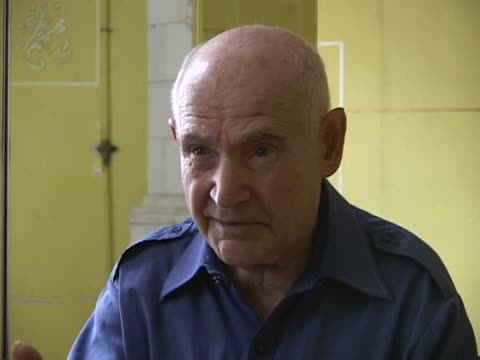
Kerler asks for the interviewee's name, and the exchange establishes his name and patronymic in Yiddish and Russian, and his surname Diner. Kerler then asks for his current address.
Diner provides personal information and talks about his family. His father was shot by the Bolsheviks in 1917. Diner was born in Skalat, but his family moved to Pidvolochysk shortly after his birth. Diner returned to Skalat after 1921.
Diner says he was born in 1917 and that his father was shot during the First World War by the Bolsheviks (the Reds) while praying, before Diner was born. He was born in Skalat, but his mother took him as a baby to Pidvolochysk, about thirty kilometres away, where he lived for years. Kerler works hard to understand the sequence, and also asks how the town names are said in Yiddish and Russian.
adds Kerler's repeated questions about ages and the Yiddish and Russian forms of the town names
Diner discusses his childhood memories and education. He attended a religious school (cheder) and then a Polish-Jewish school in Skalat. He also speaks about his family. Diner grew up with a sister and a brother. His mother passed away before he attended primary school. Leibel then lived in a orphanage in Skalat until he was twelve years old.
Diner recalls how his mother, already ill, died when he was about six, and that he had an older brother and sister, both killed in the war. He then lived in a Jewish orphanage, perhaps in Skalat (he and Kerler are confused about the place), until about twelve. He went to a Polish school, where Yiddish was also taught, and the children spoke Polish among themselves. He describes the unhappy life of the orphanage.
adds the mother's illness and death, the siblings killed in the war, and the Polish as the language among the children
Diner speaks about his adolescent years. He began an apprenticeship at a bakery and then with a cobbler. Diner worked as cobbler in Lviv, where he moved to at the age of fifteen.
Diner tells how at about twelve he was apprenticed in a bakery, which he left after two years as too hard, and then learned shoemaking in a Polish workshop. He moved to Lviv and worked as a shoemaker there from around the age of fifteen, but had no flat of his own.
In Russian, Diner talks about his life during World War II. He lived in the Donbas and Poltava regions. Diner was drafted for military service in 1941 and was demobilized in 1945.
Speaking mostly in Russian, Diner says that in wartime he worked in a mine, then as a shoemaker in Poltava, and was called into the army in 1941 and served until 1945 as a private. He says his sister and brother did not survive; his brother's children were killed too.
Diner talks about his life after the war and return to Lviv. He explains that his sister and brother did not return home. He also mentions his work at a military factory in Moscow for two years. Diner received military awards for his service. Diner got married twice and his first wife was Christian, whereas his second wife is Jewish. He raised one daughter.
Mostly in Russian, Diner describes his postwar years: he was sent to a military factory in Moscow and then returned to Lviv, with hard housing conditions. He has war medals. He married first a Russian (non-Jewish) woman who died after bearing a daughter; the daughter is in hospital and he visits her. His present wife is Jewish.
adds the Moscow factory detail, his two marriages and the daughter's illness
Diner says he has a flat and a pension and gets by today. He says he learned a little prayer in his youth and is thinking of going to the synagogue now that he is 88. S2 adds that Diner takes part in veterans' events, that his first wife died, that he has lived with his second wife for over twenty years, and that he was a good specialist with his own business.
adds the synagogue remark and S2's account of Diner's veteran status and marriages
Diner speaks about his childhood memories. He states that he stopped speaking Yiddish when joining the military. Diner's wife shows family photographs and briefly addresses her biography.
Diner says he lost his Yiddish because he lived among Russians after being drafted and finds it hard to speak now. Kerler asks about his wife, and she answers in Russian that she is Jewish, from the Poltava region, and was raised in a children's home. She shows photographs of herself and relatives and trips, including one to Odessa. The end of the passage is a recogniser loop.
adds the wife's own background and her photographs
Diner speaks about his life before the war. He was a member of the Zionist youth organization Gordonia. Diner's sister attended meetings at Hashomer Hatzair.
Diner says that as a young man in Poland he belonged to the youth organization Gordonia, while his older sister was in Hashomer Hatzair. Asked what they did there, he recalls singing and other activities but has forgotten the songs. The others in the room join in the questioning, in Russian too.
Diner talks about antisemitism, in the Polish period and in the army, where Jews were beaten, and his sister was injured. His older brother and his children, and his sister, were killed by the Germans. Kerler then explains in Yiddish that he lives in America, was earlier in England and Israel, and shows his Israeli passport.
adds antisemitism before the war and the fate of his brother's children, and Kerler's talk about himself
After a cut, S2 (presumably Dorfman) tells Kerler about the Lviv Jewish community today: the B'nai B'rith lodge and its president, its cultural, social and children's commissions, and its support for the elderly with meals and medicines. He describes the community building and mentions a conference and a visit by delegations from Europe, and a list of prewar community presidents. He mentions that the Soviets closed communal life in 1939.
Kerler chats with a community member about whether his parents spoke Yiddish, and S2 says he has studied Yiddish for three years. S2 then continues the tour, phones a colleague, and shows the social commission room and a book of registered Jews, in the community centre. A commemorative stone is mentioned.