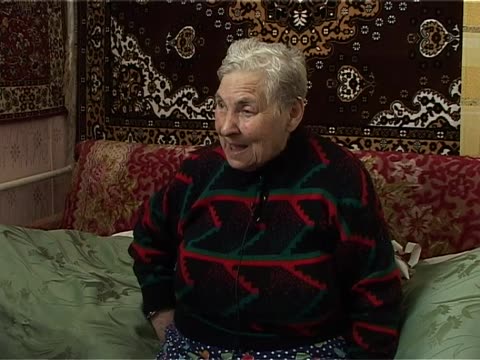
Shvartzbroit recalls her escape from the camp. She describes seeing figures in white whom she took for angels. An elderly Jew then hid the escapees in a stable with horses, and she tells of walking on toward Ozarintsy. Kerler then turns to the Yiddish school and campaigns against Yiddish.
Also includes Kerler's question about the Yiddish school and campaigns against Yiddish.
Shvartzbroit speaks about Yiddish schooling being closed and the reopening of synagogues after the war. She recalls Hasidim and Simchat Torah in Mohyliv. She tells a story of a wise rebbe who advised how to save Jews from a planned killing by buying horses, and she mentions a tzaddik to whom people went, with lights, to pray for a child. The details of the stories are garbled.
Beyond early childhood and religious life, includes the rebbe story, the tzaddik and the Shalom Aleichem reference.
Answering Kerler's question about folk cures, Shvartzbroit describes the way an evil eye was spoken away. She says that her mother had no child for thirteen years and "sold" her to a poor widow with children so that she would grow up healthy. Kerler asks about the nickname that came from this and about the rivers and the bathing she was taken through.
Adds the evil-eye spell and the question about the nickname.
Shvartzbroit talks about her work after the war. She was a foreman in a tailoring (?) workshop and then ran a matzah factory in Mohyliv, where many people worked in shifts. Her husband Yankl worked as a baker at a factory.
Shvartzbroit and Kerler talk about her late husband, who died eight years earlier, and about Kerler's own family. She also talks at length about children, grandchildren and what parents can expect in old age. She mentions relatives in Brazil. Much of the passage is garbled.
Shvartzbroit talks about relatives abroad and about her son's career and finances. She describes losing savings in the 1946 currency reform and her earlier trade in salt. She says a Jewish girl should marry a Jew. A second voice chimes in about luck and a spouse. At the end Kerler asks her about her childhood in her parents' home.
Adds the lost savings and the opinion on marrying a Jew.
Asked by Kerler for memories, Shvartzbroit speaks about a rabbi's family and a soldier in Mohyliv. She tells how she came to Luts'k after her daughter left for Germany, and she recounts a story about money and a flat that she lost through a dishonest woman. Kerler then asks her to tell again about the war years. The passage is largely garbled.
Shvartzbroit gives a detailed account of the Pechera camp. She tells of being sent out with Ukrainian Jews while Bessarabian Jews bought their way out with money, of the transport in wagons, of the dead and living in the camp and of how she was helped to leave. She then tells of her flight via Sharhorod, Murakhtu (?) and Ozarintsy to Mohyliv, where relatives took her in. Kerler's questions clarify the details.
Includes the escape route, the rescuer and help from relatives.
Shvartzbroit speaks about her grandfather, who was a cantor and a Hasid, and about few Lithuanian Jews in the town and their way of speaking Yiddish. They discuss which Yiddish is nicer. Kerler tells of his parents' origins in Volhynia and Podolia, and the two compare the years of their lives, his emigration, and a friend she supported in the war.
Adds the talk about Lithuanian Yiddish and Kerler's own background.
The interview winds down in conversation. Shvartzbroit and Kerler talk about his family in Israel and her son abroad and his children. They exchange addresses and telephone numbers and discuss contacting her son and relatives.
Shvartzbroit and Kerler discuss how to call a telephone number abroad, from America or Israel. The passage ends with a Russian-language line that appears to be a number.
Kerler phones an acquaintance (addressed as Reb Khayim) to ask whether he remembers other possible Yiddish speakers in Luts'k or the surrounding area. He thanks him, says he hopes to return to Luts'k the next year and says goodbye. Shvartzbroit asks about Ester (?) and her address.
Adds the phone call and Kerler's request for other speakers.
Shvartzbroit speaks about her past catering. She cooked and baked for celebrations and weddings. She offers Kerler her recipe and her son's address, and says that her son speaks Yiddish and sings songs on a cassette. Kerler repeatedly asks her to give the recipe for gefilte fish.
Adds the talk about cooking for weddings and her son's Yiddish songs.
Shvartzbroit explains how she makes a layered noodle-and-meat dish and then how to prepare gefilte fish: choice of carp, proportions of eggs, onions and water, baking in a pot and cooking for hours. Kerler asks about sweetness and about matzah-meal cutlets. The tape ends with thanks, blessings for a safe journey and talk of Kerler's next visit.
Covers a noodle-and-meat dish, matzah-meal cutlets and the farewell blessings besides the fish.