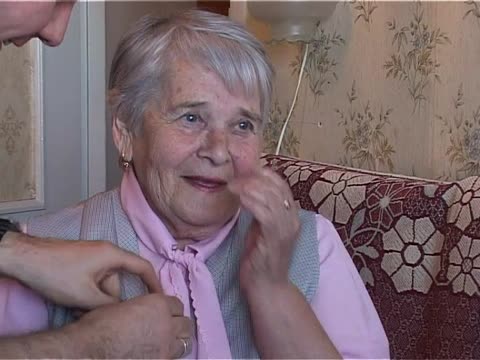
The interviewee and Kerler settle in at the start of the recording. The Yiddish is mostly garbled, with a Russian remark about where to sit. She mentions that she spoke Yiddish with older people but has no one to speak it with now.
She says she speaks Yiddish to herself at night, and Kerler explains the project: recording the real spoken Yiddish of the shtetl, prewar life and the war, and the decline of Yiddish. He records the name of her town, Sofiyivka in Polish and Trokhenbrod in Yiddish, and she says she had a private teacher at home since there was no Jewish school. They discuss the district around Luts'k, with Kerler looking at a map, and she gives her married and maiden names and her father's name.
The passage is mainly Kerler explaining the project and mapping her region, not only life today.
She gives her street address and phone number in Luts'k and her birth in Trokhenbrod. Kerler asks about the town index and the family name, and she says her father's family was Teper, with her grandfather's name given as Shimen.
She talks about relatives named Teper in America and recalls an uncle who left with the Reds in 1919. She names her parents, Avrom the merchant and Sara (called Sulke), their birth years, and her grandmothers, and says her grandfathers died young. She was the eldest of seven children, naming siblings including Shimen, Malke, Shmerl, Brokhe and Bashe; two survived and some froze to death in the forest during the war.
She recalls her childhood in the shtetl, where the family had land, orchards and fields, and describes the Polish police and school, the Catholic church and the four synagogues. She talks about the weekly Friday visit to the bath house and the mikveh. Kerler asks about the synagogue buildings and colour words, and she recalls her mother's blessing over the Sabbath candles. She says she can speak and write Yiddish well after all these years.
Adds the bath house and mikveh, the church, and the colour-word questions.
She says a teacher, Fishl der Krimer, came to the house to teach her Yiddish and Hebrew for two or three years. She was also taught blessings and prayers, though she says she has forgotten most. She talks about her mother lighting the Sabbath candles, the Friday challah, and her father taking the children to the synagogue. Her mother and grandmothers could not read, and she says the teacher was later killed.
Adds the Sabbath candles, challah and father's synagogue habits, plus the teacher's killing.
She answers questions about holiday customs at home, with Shavuot dairy food such as cheese blintzes and Passover food. She says the family bought matzo in quantity for their large household. She describes the town as a Jewish one where life was cheerful and Jews felt at home.
She talks about the youth movements of her youth, with Zionists and Communists, and says she was in Betar, whose members met in the evenings to learn Hebrew. She says she remembers a little Hebrew but cannot speak it. She also recalls songs of the movement in Yiddish and dancing.
She answers questions about the holiday cycle, including Purim with baking, gifts and costumes, Hanukkah with money, candles and latkes, and Sukkot, the sukkah and her birth on Sukkot. She also discusses the fast, the meal before Yom Kippur and chicken soup, and Kerler asks Yiddish and Polish month names. The questions mix customs with terminology.
She tells of non-Jews, mostly Poles, who spoke Yiddish and Hebrew, including a postmaster's son, and says they lived on good terms. She recalls a Jewish–gentile intermarriage and a case of conversion, which the town condemned. She lists trades and professions: tailors, builders, shoemakers, teachers, pharmacists, a barber, and doctors in Luts'k. She says her father dealt in lumber and travelled to Luts'k by horse and wagon. She mentions folk healing by her grandmother and a midwife.
Adds non-Jewish Yiddish speakers, intermarriage and conversion, and the father's lumber business.
Kerler returns to the Zionist youth movements, and she describes Betar and the sports ground in the forest where football was played and Jews gathered on the Sabbath. She talks about debates, libraries in the clubs, and a local amateur theatre where she took part in a Hasidim dance created by a young man, later in Israel. She also talks about klezmer musicians at weddings and briefly begins a song.